



- Hyaluronic acid works differently in India's humidity-rich coastal cities versus dry northern plains, and your application method must account for this.
- Applying HA on slightly damp skin is non-negotiable for effective results, especially in air-conditioned environments found across Indian metros.
- Oily skin types in Mumbai or Chennai can use HA without a heavy moisturiser on top during monsoon months.
- Multi-molecular weight HA serums deliver both surface hydration and deeper dermal plumping, making them the best choice for Indian skin diversity.
- HA layers safely with vitamin C, niacinamide, retinol, and AHAs, giving it a place in almost every Indian skincare routine.
- Sealing HA with at least a light moisturiser prevents the ingredient from drawing moisture out of your skin in dry, low-humidity conditions.
- What Is Hyaluronic Acid and Why Indian Skin Needs It
- How Hyaluronic Acid Works in India's Climate
- Types of Hyaluronic Acid: Molecular Weights Explained
- Hyaluronic Acid for Dry Skin in India
- Hyaluronic Acid for Oily Skin in India
- Hyaluronic Acid for Combination Skin in India
- How to Layer HA Serum: Step-by-Step Routine
- Common Mistakes When Using HA Serum in India
- How to Pair HA with Other Actives
- Who Uses Hyaluronic Acid Serums in India
- Related Reading
- Frequently Asked Questions
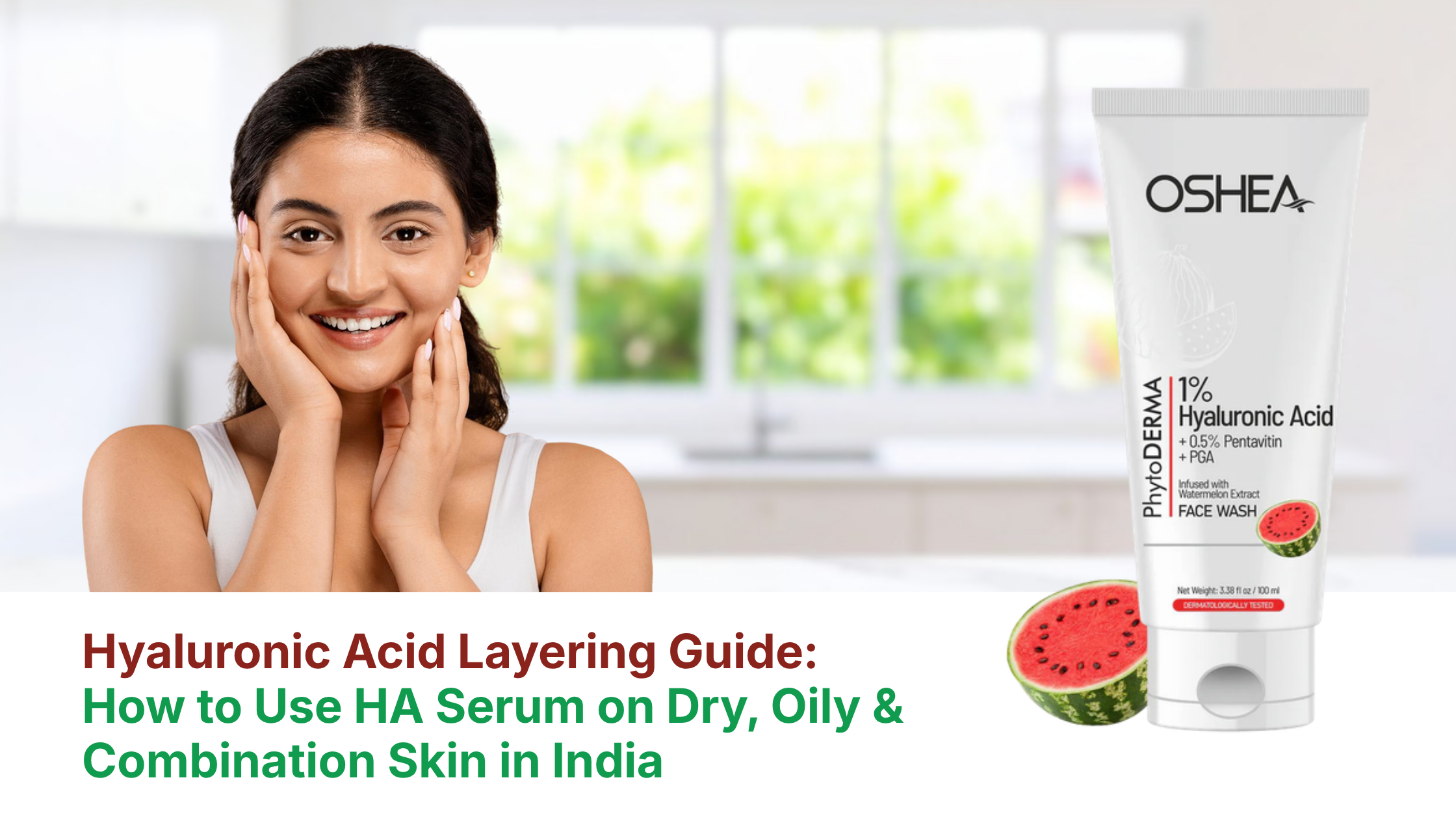
If there is one ingredient that belongs in every Indian skincare routine regardless of skin type, season, or budget, it is hyaluronic acid. Yet despite its popularity, most people in India are using it incorrectly and getting a fraction of its potential benefits. Applied to completely dry skin in an air-conditioned room in Delhi in May, HA can actually leave your skin feeling tighter than before. Applied correctly on damp skin in the same room, it delivers hours of plump, comfortable hydration. Understanding why that difference exists is what this guide is about. Explore the full range of face serums from Oshea Herbals to find the right HA formula for your skin type.
Indian skin faces a unique set of challenges that make hydration strategy more complex than global skincare guides account for. From the salt-laden humid air of Chennai to the bone-dry winters of Delhi, from the moderate coastal climate of Kochi to the altitude-driven dryness of Shimla, no single hydration approach fits all. At Oshea Herbals, our formulations are developed with these diverse Indian conditions in mind. You can learn more about our approach and ingredient philosophy on our about page.
Last reviewed: June 2026
1. What Is Hyaluronic Acid and Why Indian Skin Needs It
Hyaluronic acid (HA) is a glycosaminoglycan, a naturally occurring polysaccharide found in the skin, eyes, and connective tissue of the human body. Its primary role is to bind and retain water molecules, and it does this with remarkable efficiency. A single gram of hyaluronic acid can hold up to six litres of water, making it one of the most effective humectants known to cosmetic science.
By our mid-twenties, the skin's natural HA production begins to decline. This reduction accelerates with sun exposure, which is particularly significant in India where UV Index values regularly exceed 9 during summer months across most of the country. Research published in the Journal of Clinical and Aesthetic Dermatology confirms that UV radiation directly degrades hyaluronic acid in skin tissue, accelerating the loss of dermal volume and elasticity.
Key fact: The UV Index in Indian cities like Mumbai, Chennai, and Delhi exceeds 10 (extreme) for three to five months of the year, making UV-linked HA degradation a significant concern for Indian skin across all age groups above 25.
Indian skin, which typically has higher melanin content providing natural UV protection, still suffers from chronic dehydration, pigmentation, and uneven texture that topical HA can meaningfully address. The ingredient works at the skin surface level and does not interfere with melanin synthesis, making it suitable for all Indian skin tones without risk of lightening or darkening.
What HA Does That Moisturisers Cannot
Traditional moisturisers work primarily as occlusives or emollients: they either seal the skin surface to prevent water loss or soften the outer skin layer. Hyaluronic acid works differently. As a humectant, it actively draws moisture from the environment and from the upper dermis into the epidermis. Think of it as filling a reservoir rather than simply sealing it. This is why layering HA under a moisturiser delivers compounding benefits rather than redundant ones.
2. How Hyaluronic Acid Works in India's Climate
The effectiveness of hyaluronic acid is directly influenced by relative humidity, and India's extreme climate variability makes this relationship critical to understand. HA draws moisture from whatever is available: the air around the skin, and if the air is dry, the deeper layers of your own skin.
In cities with relative humidity below 40% such as Delhi in winter or Jaipur in summer, always apply HA serum on freshly cleansed, damp skin and seal immediately with a moisturiser. This two-step protocol prevents the ingredient from drawing moisture out of your dermis rather than from the atmosphere.
Coastal cities like Mumbai, Chennai, Kochi, and Kolkata have average relative humidity between 70% and 85% for most of the year, particularly during monsoon. In these environments, HA serum performs at its theoretical maximum because atmospheric moisture is abundant. The ingredient draws in humidity from the air and locks it into the skin, delivering plumping and smoothing effects that are immediately visible.
Landlocked northern cities such as Delhi, Lucknow, and Jaipur experience dramatically lower humidity, particularly between November and March when relative humidity can drop below 30%. In these conditions, the application technique matters far more than the product itself. Applying HA to dry skin in a dry room can leave skin feeling parched within an hour.
3. Types of Hyaluronic Acid: Molecular Weights Explained
Not all hyaluronic acid molecules are equal. The size of the molecule, measured by its molecular weight in Daltons (Da), determines how deeply it penetrates the skin and what benefits it delivers. This distinction is particularly important when choosing an HA serum for Indian skin, where multiple concerns often coexist.
| HA Type | Molecular Weight | Penetration Depth | Primary Benefit | Best For |
|---|---|---|---|---|
| High Molecular Weight HA | 1000 kDa and above | Surface layer only | Immediate plumping, protective film, reduces TEWL | All skin types, hot and humid climates |
| Medium Molecular Weight HA | 100 to 1000 kDa | Upper epidermis | Smoother texture, improved bounce | Combination skin, moderate climates |
| Low Molecular Weight HA | Below 50 kDa | Deeper epidermis and upper dermis | Structural hydration, fine line reduction | Dry skin, mature skin, low-humidity cities |
| Sodium Hyaluronate | Variable (salt form) | Epidermis | Stable, penetrates well, cost-effective | Sensitive skin, budget-friendly routines |
For Indian skin dealing with multiple issues simultaneously, a multi-weight HA serum that combines high and low molecular weight forms is the most practical choice. The high molecular weight component handles surface hydration and reduces the appearance of fine lines immediately. The low molecular weight fraction works deeper to improve structural moisture retention over time. Research from PubMed's cosmetic dermatology literature confirms that multi-weight HA formulations outperform single-weight products in both immediate and sustained hydration outcomes.
4. Hyaluronic Acid for Dry Skin in India
Dry skin in India presents with a compromised skin barrier, increased transepidermal water loss (TEWL), a dull and flaky texture, and heightened sensitivity to actives. These characteristics are exacerbated in air-conditioned offices and homes, which are ubiquitous in urban India and create an artificially low-humidity microenvironment around the skin for eight to twelve hours per day.
Morning Routine for Dry Skin in India
Begin with a gentle, cream-based cleanser that does not strip the skin's natural oils. Immediately after rinsing, while the skin is still damp, apply two to three drops of HA serum. Press it gently into the skin rather than rubbing, which disperses the product evenly and promotes absorption. Follow with a medium-weight moisturiser containing ceramides or shea butter to seal the HA layer. Apply SPF 30 or higher as the final step. Browse Oshea Herbals' moisturiser range for options formulated to complement HA application.
Evening Routine for Dry Skin in India
Double cleanse if you wear sunscreen or makeup. Apply your HA serum on damp skin as in the morning. In the evening, you can layer a richer moisturiser or a face oil on top since there is no concern about SPF occlusion. If you use retinol, apply it before the HA serum to allow it to work at the skin surface, then use HA to counteract the dryness retinol can cause.
Dry skin stat: A study published in the Indian Journal of Dermatology found that over 60% of urban Indian women reported significant facial dryness linked to air conditioning exposure, with the condition worsening between October and February in northern India.
5. Hyaluronic Acid for Oily Skin in India
The most common misconception about oily skin in India is that it does not need hydration. Oily skin produces excess sebum, but sebum is not the same as water. Many oily skin types in Indian cities are simultaneously dehydrated, a condition called combination-dehydrated skin that manifests as excess shine alongside tight, uncomfortable skin. Stripping this skin with harsh cleansers makes sebum production worse, not better.
Hyaluronic acid is one of the few actives that genuinely helps oily skin because it provides water-based hydration without adding oils or occlusives. Well-hydrated skin has less need to overproduce sebum as a compensatory mechanism. In practice, many oily-skinned individuals who introduce a lightweight HA serum into their routine report reduced shine within two to four weeks as their skin's oil regulation normalises.
Lightweight Hydration for Oily Indian Skin
Oshea Herbals' water-based serums deliver HA hydration without adding heaviness or congestion to oily skin types. Ideal for Mumbai's humidity and Delhi's summer heat.
Shop Face SerumsRoutine Tips for Oily Skin in Humid Cities
In cities like Mumbai and Chennai with humidity above 70%, oily skin types can often skip a separate moisturiser during monsoon months and use a gel moisturiser or nothing at all over their HA serum. The ambient humidity provides sufficient moisture for HA to work. In drier months or in air-conditioned environments, a light oil-free gel-cream is needed to seal the serum. Look for Oshea Herbals' face wash range to pair a non-stripping cleanser with your HA routine.
6. Hyaluronic Acid for Combination Skin in India
Combination skin presents perhaps the most common skin type among Indian urban populations. It is characterised by an oily T-zone (forehead, nose, and chin) with normal to dry cheeks. India's seasonal swings intensify this pattern: during summer and monsoon, the T-zone becomes extremely oily while the cheeks may remain comfortable; during winter, the cheeks dry out severely while the T-zone may remain mildly oily.
Zone-by-Zone Application for Combination Skin
For combination skin, apply the same HA serum across the full face but adjust what you layer on top. On oily zones, seal with a gel moisturiser or a mattifying SPF. On dry cheek zones, use a slightly richer moisturiser. This one-serum, two-moisturiser approach allows you to use a single HA product effectively without over-hydrating the T-zone or under-hydrating the cheeks. Check Oshea Herbals' full skincare collection for a compatible routine.
7. How to Layer HA Serum: Step-by-Step Routine
The sequence in which you apply skincare products matters significantly when using active ingredients like hyaluronic acid. The general rule is thinnest to thickest texture, with actives applied closest to clean skin. However, there are specific layering considerations for HA that differ from most actives.
Morning Layering Sequence
Cleanse with water or a gentle cleanser. While skin is still damp, apply any water-based toner or essence first. Then apply hyaluronic acid serum, pressing it into damp skin. Allow thirty to sixty seconds for absorption. Apply vitamin C serum if using one (note: some prefer vitamin C first, then HA, both approaches work as long as skin is damp). Apply eye cream. Apply moisturiser. Finish with SPF, which should be the last step in the morning routine without exception.
Evening Layering Sequence
Oil cleanser to remove SPF and makeup, followed by a water-based cleanser. Apply any chemical exfoliant (AHA or BHA) if it is an exfoliation night, then allow it to absorb for ten minutes. Apply HA serum on slightly damp skin. Layer retinol if using it, and then apply HA on top to counteract dryness. Finish with a moisturiser appropriate for your skin type. For dry skin, add a face oil as the final occlusive layer.
Never apply HA serum as the very last step in your routine with nothing on top. HA is a humectant, not an occlusive. Without a sealing layer, it continues to attract and release moisture, and in a dry indoor environment the net result can be increased water loss rather than retention.
8. Common Mistakes When Using HA Serum in India
Applying to Dry Skin in Air-Conditioned Spaces
This is the single most common mistake. Indian professionals spend six to ten hours daily in air-conditioned offices where humidity can drop to 20 to 30%. Applying HA to completely dry skin in these conditions means the ingredient draws moisture from your own dermis rather than from the atmosphere, reversing its intended effect. Always spray a facial mist or apply on post-cleanse damp skin before using HA serum.
Using HA Without a Sealing Moisturiser
Particularly in northern and central India from October to February, skipping the moisturiser step after HA is a critical error. HA must be sealed in with an occlusive or emollient layer to prevent it from evaporating off the surface. Even a thin layer of moisturiser is sufficient; the heavier the moisturiser, the more occlusive the seal.
Expecting HA to Replace a Moisturiser
Hyaluronic acid is a humectant and a serum ingredient. It draws water, but it does not prevent that water from evaporating on its own. A moisturiser contains emollients and occlusives that seal the hydration delivered by HA. Eliminating moisturiser from the routine because HA is present leads to ongoing dehydration regardless of how good the HA product is.
Do not confuse sodium hyaluronate (the salt form) with hyaluronic acid on ingredient labels. Both are effective, but sodium hyaluronate has a smaller molecular size and penetrates slightly better. If sodium hyaluronate appears high on the ingredient list, the product is well-formulated even without the phrase hyaluronic acid in the name.
9. How to Pair HA with Other Actives
One of hyaluronic acid's greatest strengths in an Indian skincare context is its compatibility with virtually every other active ingredient. It is pH neutral and chemically inert as a topical ingredient, meaning it does not destabilise vitamin C, retinol, or exfoliating acids.
HA with Vitamin C
An excellent pairing for hyperpigmentation and dullness, both of which are common concerns among Indian skin types. Apply vitamin C on clean damp skin, wait one minute, then apply HA on top. The brightening power of vitamin C is enhanced when the skin is well-hydrated. Look for Oshea Herbals' vitamin C and brightening serums that can be paired with HA in your routine.
HA with Niacinamide
A powerful combination for oily and acne-prone Indian skin. Niacinamide regulates sebum, minimises pores, and reduces post-inflammatory hyperpigmentation. HA provides the hydration that keeps skin barrier intact. These two ingredients can be applied simultaneously or in any order, and many effective Indian skincare products now combine both in a single formula.
HA with Retinol
Retinol is a gold-standard anti-ageing ingredient but is notorious for causing dryness and irritation, particularly on Indian skin that has not been previously conditioned. Sandwiching retinol between two HA applications (one before, one after) is a widely practised method for reducing retinol-induced dryness without compromising its efficacy. Research in Dermatologic Surgery supports combining retinol with humectants to improve tolerability.
HA with AHAs and BHAs
Chemical exfoliants accelerate cell turnover but temporarily disrupt the skin barrier, increasing TEWL. Using HA after an AHA or BHA treatment replenishes the moisture lost during exfoliation and helps restore barrier function faster. Apply your exfoliant, wait ten minutes, then apply HA as the next step. This reduces the redness and flaking that some Indian skin types experience after acid exfoliation.
Expert insight: Dermatologists at the All India Institute of Medical Sciences (AIIMS) have noted in published clinical reviews that humectant-based serums like HA are among the safest and most tolerable actives for all Fitzpatrick skin types IV through VI, which comprise the majority of the Indian population.
10. Who Uses Hyaluronic Acid Serums in India
Hyaluronic acid has moved beyond its original positioning as an anti-ageing ingredient and is now used across age groups, skin types, and demographic segments in India. The following breakdowns illustrate where HA fits across different skincare needs.
- Always apply HA serum on damp skin: this is the single most impactful technique change you can make, especially in air-conditioned Indian environments.
- Seal HA with a moisturiser every time, regardless of skin type, to prevent moisture loss through evaporation.
- Choose multi-molecular weight HA for the most comprehensive hydration across both surface and dermal layers.
- Oily skin in humid Indian cities benefits tremendously from lightweight HA serum and often needs less moisturiser on top during monsoon months.
- HA is safe to combine with all major actives including vitamin C, niacinamide, retinol, and AHAs, making it the most versatile ingredient in any Indian skincare routine.
- Dry skin in low-humidity northern Indian winters requires more rigorous occlusion after HA application to prevent the ingredient from drawing moisture from the dermis.
11. Related Reading
12. Frequently Asked Questions
Should I apply hyaluronic acid on wet or dry skin?
Apply hyaluronic acid on slightly damp skin, ideally within 60 seconds of washing your face or after a hydrating toner. HA draws moisture from its surroundings; damp skin provides the surface water it needs to pull into the deeper layers. On completely dry skin in a low-humidity environment, HA can draw moisture upward from the dermis instead, which may cause temporary tightness.
Can I use hyaluronic acid serum in humid Indian summers?
Yes, HA serum works well in humid Indian summers, especially for oily and combination skin types. High ambient humidity means there is plenty of atmospheric moisture for HA to bind. Use a lightweight, water-based HA serum and skip heavy occlusive moisturisers on top during peak humidity months. A gel-cream or light lotion is sufficient to seal in the hydration.
How many times a day should I apply hyaluronic acid in India?
Twice daily, once in your morning routine and once at night, is the standard recommendation. Morning application keeps skin plumped and primed under sunscreen. Night application supports the skin's overnight repair cycle. If you live in a very dry, air-conditioned environment, a midday reapplication over makeup is acceptable using an HA mist.
Does hyaluronic acid cause purging or breakouts?
Pure hyaluronic acid is non-comedogenic and does not cause purging or breakouts on its own. However, some HA serums contain added fragrance, alcohols, or silicones that can irritate acne-prone skin. Always check the full ingredient list. If you experience new breakouts after starting an HA serum, the likely culprit is a co-ingredient rather than the hyaluronic acid itself.
Can I mix hyaluronic acid with vitamin C serum?
Yes, HA and vitamin C are compatible and work well together. Apply vitamin C serum first on clean skin, let it absorb for one to two minutes, then apply HA serum on top. This layering sequence allows vitamin C to penetrate optimally at its preferred low pH before HA creates a hydrating layer over it. Both actives together deliver brightening and plumping benefits simultaneously.
What molecular weight of hyaluronic acid is best for Indian skin?
A multi-molecular weight HA formula works best for most Indian skin types. Low molecular weight HA (below 50 kDa) penetrates deeper into the dermis for structural hydration. High molecular weight HA (above 1000 kDa) sits on the surface and forms a protective film that reduces transepidermal water loss. In India's mixed climate conditions, a product combining both weights delivers both surface and deep-layer hydration benefits.
Is hyaluronic acid safe during pregnancy in India?
Topical hyaluronic acid is widely considered safe during pregnancy. It is a substance naturally produced by the body, and topical application does not involve systemic absorption in meaningful quantities. However, always consult your gynaecologist or dermatologist before starting or continuing any new skincare ingredient during pregnancy, as individual circumstances vary.
Why does my skin feel tight after using hyaluronic acid serum?
Tightness after HA serum application typically occurs when you apply it to dry skin in a low-humidity environment such as an air-conditioned room. Without sufficient atmospheric moisture available, HA pulls water from deeper skin layers toward the surface, which can cause a temporary tight or dry feeling. The fix is to apply HA on damp skin and seal immediately with a moisturiser to trap the hydration in place.


