


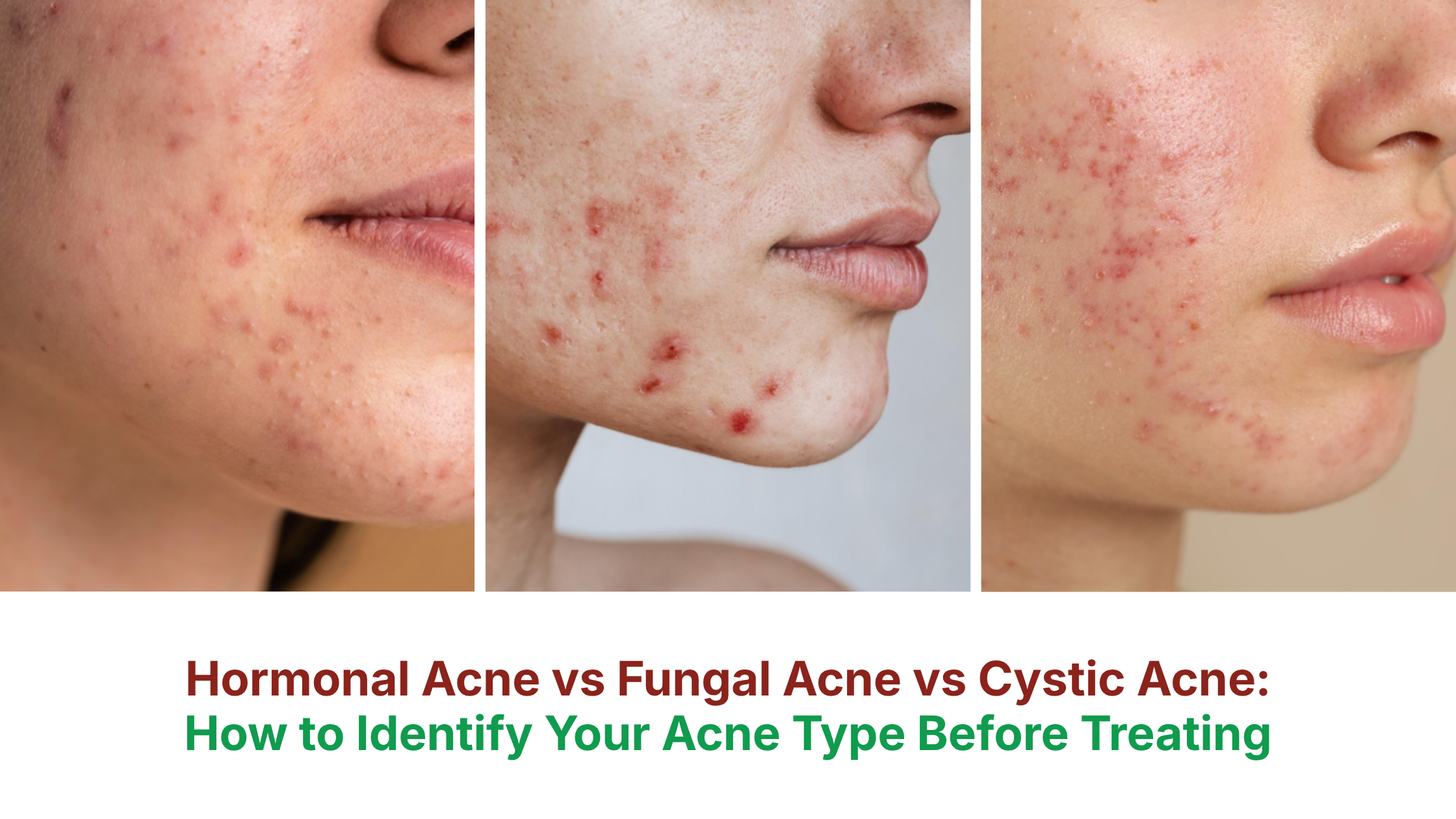
- Hormonal, fungal, and cystic acne each have distinct visual signatures, triggers, and locations on the face and body that allow for identification without a clinical diagnosis in most cases.
- Fungal acne is caused by yeast, not bacteria, and will not respond to standard anti-acne products: this misidentification is the leading cause of treatment failure in India.
- Cystic acne is a medical condition requiring dermatological attention; attempting to extract cysts at home dramatically increases the risk of permanent scarring.
- India's climate, particularly monsoon heat and humidity, is a direct trigger for fungal acne on the chest, back, and forehead.
- Hormonal acne in Indian women is strongly linked to PCOS, which affects an estimated one in five women in India according to published epidemiological data.
- Identifying your acne type before starting treatment is the most important step, as the wrong treatment can actively worsen specific acne types.
- Why Acne Type Identification Matters Before Treatment
- How Acne Forms: The Core Mechanism
- Comparison: Hormonal, Fungal, and Cystic Acne at a Glance
- Hormonal Acne in India: Causes, Patterns, and Triggers
- Fungal Acne in India: Why It Thrives in Indian Heat and Humidity
- Cystic Acne in India: Causes, Severity, and Risk Factors
- How to Choose the Right Treatment for Your Acne Type
- Common Mistakes That Worsen Each Acne Type
- Skincare Routine Adjustments by Acne Type
- Who Gets Each Type of Acne in India
- Related Reading
- Frequently Asked Questions
Walk into any pharmacy in India and you will find shelves stacked with acne treatments. Salicylic acid face washes, benzoyl peroxide gels, neem-based creams, and herbal spot treatments all promise clear skin. Yet a significant proportion of people who use them consistently see no improvement, or actively get worse. The reason is almost always the same: they are treating the wrong type of acne. Explore Oshea Herbals' acne care range, developed to address the specific acne patterns common to Indian skin.
Acne is not a single condition. Hormonal acne, fungal acne, and cystic acne share the word acne but are caused by completely different biological mechanisms. Treating fungal acne with antibacterial products is like treating a fungal nail infection with antibiotic cream: the mechanism does not match and the treatment will not work. At Oshea Herbals, we have developed formulations that target specific acne-related concerns for Indian skin. Learn more about our ingredient standards on the Oshea Herbals about page.
Last reviewed: June 2026
1. Why Acne Type Identification Matters Before Treatment
The Indian skincare market has grown considerably in the past decade, but acne remains one of the most commonly mismanaged skin conditions in the country. A survey cited in the Indian Journal of Dermatology, Venereology and Leprology found that acne affects approximately 9.4% of the global population, with prevalence significantly higher in India due to dietary patterns, climate, stress, and the high incidence of polycystic ovary syndrome (PCOS).
The critical problem in India is that the three most common types of acne, namely hormonal, fungal, and cystic, are frequently confused with one another. Each requires a fundamentally different approach. Fungal acne requires antifungal treatment. Hormonal acne requires addressing the underlying endocrine trigger. Cystic acne in its severe form requires medical intervention. Applying a salicylic acid face wash to all three conditions will help one type, have no effect on another, and potentially worsen the third.
Key fact: Studies suggest that Malassezia folliculitis (fungal acne) is misdiagnosed as bacterial acne in a significant percentage of cases in tropical climates, leading to prolonged ineffective treatment periods of six months or more in some patients.
2. How Acne Forms: The Core Mechanism
Standard bacterial acne (acne vulgaris) follows a predictable four-step process. First, excess sebum production clogs a hair follicle. Second, dead skin cells accumulate inside the clogged pore. Third, Cutibacterium acnes bacteria (formerly Propionibacterium acnes) colonise the blocked follicle. Fourth, the immune system mounts an inflammatory response, producing a visible pimple. This is the acne that salicylic acid, benzoyl peroxide, and neem-based treatments are designed to address.
Fungal acne bypasses the bacterial step entirely. Malassezia yeast, which naturally lives on human skin, overpopulates hair follicles when conditions favour its growth: heat, sweat, humidity, and a diet rich in carbohydrates and sugars. The resulting condition looks like acne but has nothing to do with bacterial colonisation.
Cystic acne uses the bacterial pathway but with an exaggerated inflammatory response. The immune reaction is so intense that it breaks through the follicle wall into surrounding tissue, creating a large, fluid-filled cyst deep within the dermis rather than a surface-level pustule.
Before purchasing any acne treatment in India, spend five minutes comparing your breakout pattern against the identification criteria in this guide. Identifying the correct type first saves months of ineffective treatment and prevents unnecessary scarring or worsening.
3. Comparison: Hormonal, Fungal, and Cystic Acne at a Glance
| Feature | Hormonal Acne | Fungal Acne | Cystic Acne |
|---|---|---|---|
| Cause | Androgen fluctuations, PCOS, stress | Malassezia yeast overgrowth | Deep bacterial infection, severe inflammation |
| Appearance | Painful papules, cysts, sometimes whiteheads | Small, uniform, itchy follicular bumps | Large, deep, red, painful cysts and nodules |
| Location | Chin, jawline, neck, lower cheeks | Forehead, chest, upper back, shoulders | Cheeks, jawline, neck, back |
| Pattern | Cyclical, worse before menstruation | Clusters of identical bumps, may worsen with sweat | Persistent, does not resolve quickly |
| Itchiness | Usually not itchy | Often itchy | Usually not itchy, but very tender |
| Treatment approach | Hormonal regulation, niacinamide, retinol | Antifungal: zinc pyrithione, ketoconazole | Dermatologist prescribed: retinoids, antibiotics |
| Scarring risk | Moderate, especially with picking | Low if treated correctly | High, permanent scarring without treatment |
| Indian climate trigger | Stress, dietary changes, winter indoor heat | Monsoon, summer sweating, gym workouts | Heat, dietary factors, hormonal shifts |
4. Hormonal Acne in India: Causes, Patterns, and Triggers
Hormonal acne is driven by fluctuations in androgens, the family of hormones that includes testosterone. When androgen levels rise, sebaceous glands produce more sebum, increasing the likelihood of pore blockage and bacterial colonisation. In Indian women, hormonal acne is disproportionately linked to PCOS. Research published in the Journal of Human Reproductive Sciences indicates that PCOS affects up to 22.5% of Indian women, one of the highest prevalence rates in the world.
Identifying Hormonal Acne
The defining characteristic of hormonal acne is its location: the lower third of the face. The chin, jawline, sides of the neck, and lower cheeks are the primary zones. This pattern is consistent because androgen receptors are densely concentrated in the sebaceous glands of these areas. Hormonal acne tends to appear as deep, painful bumps rather than surface-level blackheads or whiteheads. In women, the breakouts consistently worsen in the week before menstruation.
Hormonal Acne Triggers Specific to India
Beyond PCOS and the natural menstrual cycle, Indian lifestyle factors that drive hormonal acne include high stress from competitive academics and workplace environments, irregular sleep patterns, a diet heavy in dairy and high-glycaemic foods, and the widespread use of hormonal contraceptives, which some formulations can worsen acne while others improve it. Seasonal changes in India also play a role: the transition from summer to monsoon and from monsoon to winter are frequently reported as breakout triggers. Visit the Oshea Herbals face wash collection for gentle cleansers appropriate for hormonal acne-prone skin.
5. Fungal Acne in India: Why It Thrives in Indian Heat and Humidity
Fungal acne, whose clinical name is Malassezia folliculitis or pityrosporum folliculitis, is a condition uniquely suited to thrive in Indian conditions. Malassezia yeast is lipophilic, meaning it feeds on the fatty acids present in sebum and sweat. It colonises hair follicles on the scalp, face, chest, and back in virtually everyone, but typically causes no problems. The issue begins when conditions tip the yeast population from balanced to overgrown.
Why India's Climate Accelerates Fungal Acne
Malassezia thrives in temperatures between 32 and 37 degrees Celsius with high humidity, which describes most of coastal India for seven to nine months of the year. Monsoon season, when temperature and humidity combine optimally for yeast growth, sees the highest incidence of fungal acne reports in Indian dermatology practices. Sweating during outdoor commutes, wearing synthetic fabrics in heat, and applying heavy, oil-based skincare products all feed Malassezia and promote overgrowth.
Clear, Calm Skin Starts with the Right Cleanser
Oshea Herbals face washes and cleansers are formulated to keep skin balanced during India's most challenging seasons without stripping the natural barrier.
Shop Face WashesIdentifying Fungal Acne vs Regular Acne
The key diagnostic clues for fungal acne are uniformity and itch. Fungal acne bumps are remarkably consistent in size, almost like a field of identical small bumps rather than a mix of whiteheads, blackheads, and larger pimples. They are most commonly found on the forehead, hairline, chest, and upper back. The itch is distinctive: a persistent low-level itchiness that does not accompany standard bacterial acne. If your breakout worsens after workouts or prolonged sweating, fungal acne is a strong possibility. Use Oshea Herbals' gentle cleansers after exercise to help manage fungal acne triggers.
Clinical insight: A study in the Journal of the American Academy of Dermatology found that Malassezia folliculitis was commonly misdiagnosed as acne vulgaris, with affected patients having already undergone prolonged antibiotic treatment without improvement before correct diagnosis. Antibiotic use may actually worsen fungal acne by clearing competing bacteria and allowing Malassezia to proliferate further.
6. Cystic Acne in India: Causes, Severity, and Risk Factors
Cystic acne is the most severe form of acne vulgaris and represents the end of a spectrum that begins with mild blackheads. What distinguishes a cyst from a regular pimple is depth and inflammation severity. When the bacterial infection and resulting immune response become so intense that the follicle wall ruptures, the infection spreads into the surrounding dermis, creating a painful, fluid-filled cyst that cannot be seen to have a surface opening.
Risk Factors for Cystic Acne in India
Genetics is the single strongest predictor: if parents or siblings had cystic acne, the likelihood of developing it is significantly higher. Among Indians, cystic acne is seen more commonly in teenagers and young adults between 14 and 25 years, though it can persist into the thirties and forties, particularly in women with hormonal imbalances. Additional risk factors include high-glycaemic dietary patterns prevalent in urban India, chronic stress, and the use of comedogenic skincare or hair products.
Cystic Acne and Post-Inflammatory Hyperpigmentation in Indian Skin
For Indian skin types spanning Fitzpatrick scale III through V, the aftermath of cystic acne poses a serious additional concern. Post-inflammatory hyperpigmentation (PIH), the dark marks left after an inflamed breakout heals, is significantly more pronounced in higher melanin skin tones. A single cyst that resolves without treatment can leave a dark spot that persists for three to eighteen months. Proper treatment not only resolves the cyst faster but dramatically reduces the PIH burden that follows.
7. How to Choose the Right Treatment for Your Acne Type
Once you have identified your acne type using the comparison table and the identification criteria above, the treatment pathway becomes considerably clearer. This section outlines what each type responds to and what to avoid.
Treating Hormonal Acne
Topical treatments for hormonal acne include niacinamide to regulate sebum production, retinoids to increase cell turnover and prevent pore blockage, and azelaic acid to reduce inflammation and PIH. These should be combined with dietary modifications: reducing dairy and high-glycaemic foods, and managing stress. Severe hormonal acne, particularly PCOS-linked acne, requires evaluation by a dermatologist or endocrinologist who may prescribe hormonal therapy. Browse Oshea Herbals' face serum range for niacinamide and brightening options.
Treating Fungal Acne
Antifungal ingredients are essential. Over-the-counter options that help include zinc pyrithione (found in some anti-dandruff shampoos used as face and body wash), selenium sulphide, and ketoconazole, which requires a prescription in India. Importantly, stop using any oil-based products, coconut oil, fatty acids in serums, or occlusive moisturisers on affected areas as these feed Malassezia. Switch to lightweight, non-comedogenic, water-based products on fungal acne areas.
Treating Cystic Acne
Cystic acne requires dermatological intervention for all but the mildest cases. Topical retinoids are a standard first-line prescription. Moderate to severe cases may require oral antibiotics for a defined course to reduce bacterial load, or in persistent cases, oral isotretinoin under close medical supervision. The Indian Association of Dermatologists, Venereologists and Leprologists (IADVL) publishes treatment guidelines for acne management in Indian patients.
8. Common Mistakes That Worsen Each Acne Type
Hormonal Acne Mistakes
Aggressively over-cleansing is the most common error. Stripping the skin's natural oils triggers sebum overproduction, worsening the very excess sebum that drives hormonal breakouts. Using multiple harsh actives simultaneously, such as benzoyl peroxide, AHAs, and retinol all in the same routine, causes barrier disruption that prolongs healing. Patience is essential: hormonal acne treatments take four to six weeks to show meaningful results.
Fungal Acne Mistakes
Continuing to use oil-based products after identifying fungal acne will prevent any improvement regardless of antifungal treatment. This includes face oils, oil-based serums, and heavy moisturisers. Wearing tight, synthetic clothing over chest and back fungal acne creates the heat and sweat environment Malassezia needs. Using antibacterial treatments or taking oral antibiotics for what is actually fungal acne actively worsens the condition by eliminating competing bacteria.
Never attempt to extract or pop a cystic acne lesion at home. The cyst sits deep in the dermis, and applying surface pressure ruptures the cyst wall laterally, spreading infection into surrounding tissue. This increases inflammation, extends healing time by weeks, and dramatically raises the probability of permanent scarring and deep PIH marks that are extremely difficult to treat on Indian skin tones.
Cystic Acne Mistakes
Delaying professional treatment in the hope that cysts will resolve on their own is a common and costly mistake. Without intervention, each cyst spends additional weeks inflamed, and the deeper and longer it remains inflamed, the more likely it is to leave a permanent scar or deeply pigmented mark. Icing a cyst for ten to fifteen minutes can temporarily reduce swelling and discomfort while awaiting a dermatology appointment, but is not a treatment.
9. Skincare Routine Adjustments by Acne Type
Routine for Hormonal Acne
Morning: gentle cleanser suited to acne-prone skin, niacinamide serum, lightweight moisturiser, SPF 30 minimum. Evening: gentle cleanser, retinoid (starting low and building up gradually), lightweight moisturiser. Avoid: fragrance, heavy face oils, comedogenic ingredients such as isopropyl myristate and coconut oil. Look for Oshea Herbals' acne-appropriate face washes as a starting point for your cleanser.
Routine for Fungal Acne
Morning: antifungal or zinc-based cleanser, water-based non-comedogenic moisturiser, SPF. Evening: antifungal cleanser, very light water-based gel moisturiser. Actively avoid all oils on affected areas. Do not use sheet masks on fungal acne zones. Wash pillowcases and towels at least twice weekly during active outbreaks. Check ingredient lists for fatty acids like lauric acid, oleic acid, and linoleic acid as these feed Malassezia.
Routine for Cystic Acne
Morning: gentle non-stripping cleanser, prescribed topical treatment as directed, oil-free moisturiser, broad-spectrum SPF 50. Evening: gentle cleanser, prescribed topical retinoid or other treatment. Absolutely no physical exfoliation or harsh scrubs on active cysts. Apply a cold compress to painful cysts for temporary relief. Prioritise skin barrier repair alongside prescribed treatments using gentle, minimal ingredient products from Oshea Herbals' skincare range.
Routine insight: Dermatologists at AIIMS and leading Indian skin clinics consistently emphasise that the number one predictor of acne treatment success is consistency over a minimum six-week period, rather than the specific products used. Routine adherence matters more than individual product selection for most mild to moderate cases.
10. Who Gets Each Type of Acne in India
- Always identify your acne type before starting any treatment, as the wrong approach can worsen specific types, particularly fungal acne when treated with antibacterials.
- Fungal acne is defined by uniform small bumps, itch, and clusters on the forehead, chest, and back: if these match your breakout, antifungal treatment is required.
- Hormonal acne concentrates on the lower face (chin, jaw, neck) and follows a cyclical pattern: dietary changes and targeted topicals are the first line of intervention.
- Cystic acne requires dermatological attention: home treatment delays increase scarring risk significantly, particularly for darker Indian skin tones prone to PIH.
- India's climate (heat, humidity, and monsoon) makes fungal acne significantly more common than in temperate countries, and it is routinely underdiagnosed.
- Post-inflammatory hyperpigmentation from acne is a compounding concern for Indian skin: treating acne properly and promptly is the most effective PIH prevention strategy.
11. Related Reading
12. Frequently Asked Questions
How do I know if my acne is hormonal or fungal?
Hormonal acne appears as larger, deeper, and often painful cysts or papules concentrated around the chin, jawline, and neck, frequently flaring before menstruation. Fungal acne consists of small, uniform, itchy bumps that appear in clusters, most commonly on the forehead, chest, and upper back. If your breakout itches and the bumps are consistently small and similar in size, fungal acne is more likely. If the bumps are deep, painful, and linked to your cycle, hormonal acne is more likely.
Can fungal acne be treated with regular anti-acne products?
No. Fungal acne is caused by Malassezia yeast, not bacteria. Standard anti-acne products containing benzoyl peroxide or salicylic acid target bacterial acne and will not treat fungal acne. Using them on fungal acne without addressing the yeast may even worsen the condition by disrupting the skin microbiome. Antifungal ingredients such as zinc pyrithione, selenium sulphide, or ketoconazole are required to treat fungal acne.
Why does my cystic acne keep coming back in the same spots in India?
Cystic acne recurs in the same spots because the deep sebaceous gland that triggered the original cyst may never fully clear. Once a cystic breakout heals, the gland can become blocked again with new sebum, triggering another cyst in the identical location. Hormonal triggers such as androgen fluctuations amplify this pattern. In India, additional triggers include high-glycaemic diets, dairy consumption, heat, and stress. Addressing the root hormonal cause with a dermatologist is necessary to break the recurring cycle.
Is sweating during Indian summers a trigger for fungal acne?
Yes, sweating is a significant trigger for fungal acne. Malassezia yeast thrives in warm, moist environments. During Indian summers, sweat accumulates on the forehead, chest, and back, creating exactly the conditions the yeast needs to overpopulate. Wearing breathable fabrics, showering promptly after sweating, and using an antifungal cleanser on affected areas during summer months can prevent flares.
Can I pop cystic acne at home?
No. Attempting to pop or extract cystic acne at home is strongly inadvisable. Cysts form deep within the dermis, and applying pressure forces the infection deeper and sideways into surrounding tissue, spreading the inflammation. This significantly increases the risk of permanent scarring and post-inflammatory hyperpigmentation, which is already a major concern for Indian skin tones. A dermatologist can drain cysts under sterile conditions using a precise technique that minimises scarring risk.
What foods trigger hormonal acne in India?
High-glycaemic foods such as white rice, maida-based foods, sugary mithai, sweetened chai, and packaged snacks spike insulin levels, which in turn elevate androgen activity and sebum production, worsening hormonal acne. Dairy products, particularly full-fat milk, are linked to acne flares through IGF-1 hormone pathways. In India, the heavy consumption of fried street food during festivals and celebrations is also frequently reported as an acne trigger. Reducing these food categories often produces visible improvement in hormonal breakouts within four to six weeks.
How long does it take for cystic acne to go away?
An individual cystic pimple can take two to six weeks to resolve, significantly longer than surface-level pimples which typically resolve in one to two weeks. This is because the inflammation is deep within the dermis and requires the body's immune response to break down the cyst wall and clear the contents. Without treatment, cysts are prone to scarring. With appropriate topical or oral treatment prescribed by a dermatologist, resolution can be accelerated to one to three weeks.
What is the difference between acne vulgaris and fungal acne?
Acne vulgaris is caused by Cutibacterium acnes bacteria thriving in blocked pores. It presents as blackheads, whiteheads, papules, pustules, and in severe cases, cysts and nodules. Fungal acne, technically called Malassezia folliculitis, is caused by an overgrowth of Malassezia yeast in hair follicles. It presents exclusively as small, uniform, itchy follicular papules. The two conditions look similar to the untrained eye but require completely different treatments: antibacterial approaches for acne vulgaris and antifungal approaches for fungal acne.


