






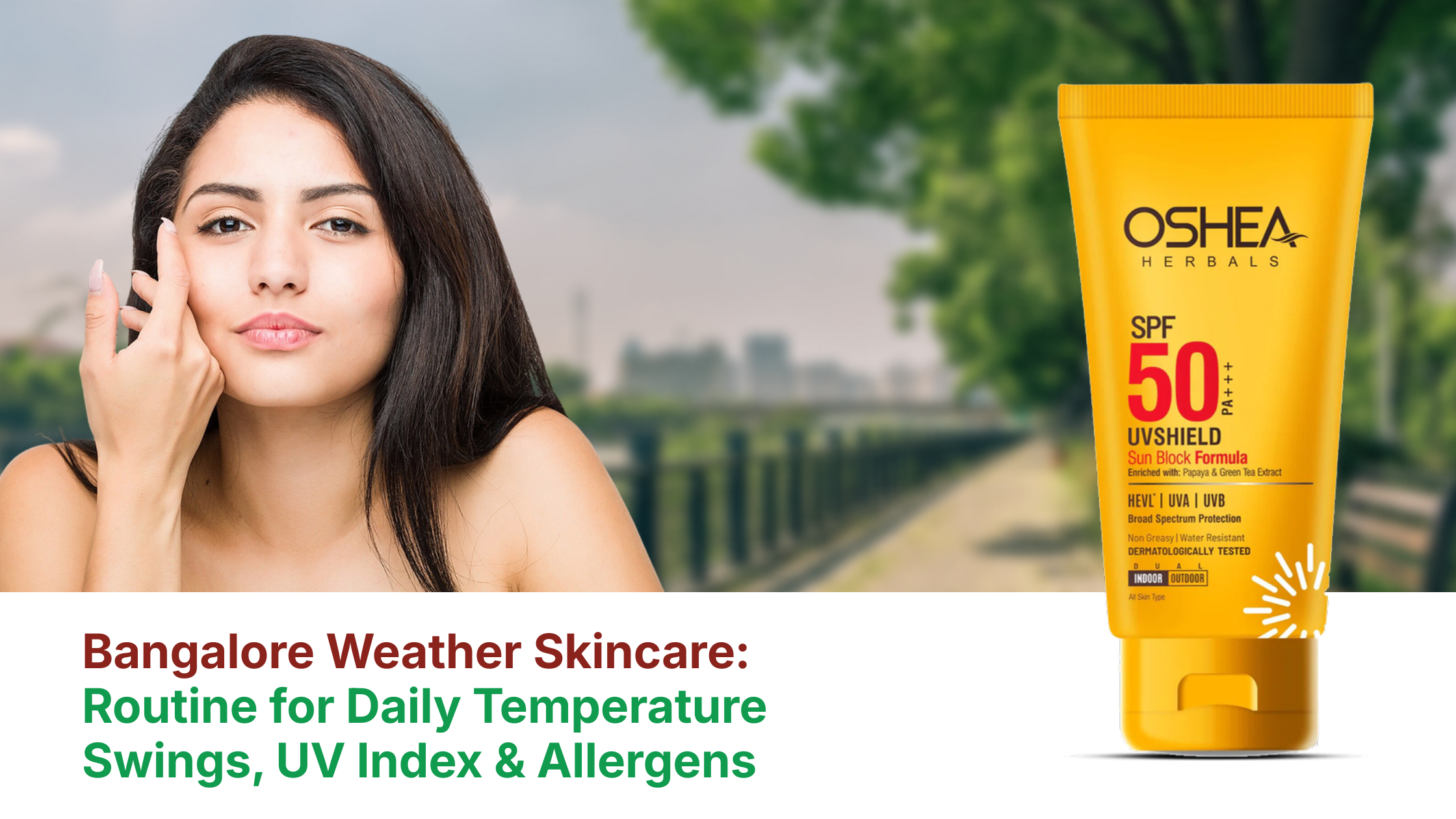
- Bangalore's altitude of approximately 920 metres above sea level makes its UV radiation measurably more intense than coastal cities at the same latitude: SPF 50 is the appropriate daily minimum.
- Daily temperature swings of 10 to 14 degrees Celsius between afternoon and evening repeatedly stress the skin's vascular system, making Bangalore uniquely prone to sensitivity, redness, and reactive skin flares.
- Bangalore's flowering trees and seasonal pollen are among the highest of any Indian city, triggering allergic skin reactions during pre-monsoon (March to June) and early monsoon seasons.
- Moderate humidity throughout the year means Bangalore supports a consistent, year-round base routine with only minor product adjustments across seasons, unlike Delhi or Mumbai.
- Hard water in large areas of Bangalore disrupts the acid mantle and contributes to skin dryness and tightness, making a pH-balancing toner a practical daily addition.
- Centella asiatica and niacinamide are the two most valuable active ingredients for Bangalore skin: they manage temperature-swing-triggered redness, barrier disruption, and seasonal allergen reactions simultaneously.
- Bangalore's Climate: What Makes It Unique for Skin
- How Temperature Swings Affect Skin Biology
- Bangalore's UV Index: Higher Than You Think
- Seasonal Allergens and Reactive Skin in Bangalore
- The Bangalore Morning Skincare Routine
- The Bangalore Evening Skincare Routine
- Bangalore Skincare by Season
- Managing Sensitivity and Redness in Bangalore
- Hard Water and Bangalore Skin: What to Know
- Who Needs a Bangalore-Specific Skincare Approach
- Related Reading
- Frequently Asked Questions
Bangalore has a reputation as India's most liveable city, and from a skincare perspective, its moderate climate seems straightforward on the surface. But Bangalore presents a specific set of skin challenges that are genuinely distinct from both dry northern India and humid coastal India: dramatic daily temperature swings, a high UV Index amplified by altitude, some of the densest pollen seasons of any Indian city, and increasingly hard water from stressed groundwater sources. The result is a city where sensitive and reactive skin types struggle particularly, and where a one-size approach consistently fails. Explore Oshea Herbals' complete skincare collection for formulations suited to Bangalore's variable conditions.
This guide addresses each of Bangalore's specific skin challenges and provides a flexible, adaptable routine that handles the city's characteristic variability. Oshea Herbals' approach to climate-aware formulation is detailed on our about page.
Last reviewed: June 2026
1. Bangalore's Climate: What Makes It Unique for Skin
Bangalore sits at an elevation of approximately 920 metres above sea level on the Deccan Plateau, which gives it a subtropical highland climate that is fundamentally different from lowland Indian cities. Average daily high temperatures range from 27 to 34 degrees Celsius, but lows in the same 24-hour period can drop to 15 to 22 degrees Celsius. This creates temperature differentials of 10 to 14 degrees Celsius within a single day, a pattern that has no equivalent in Mumbai's consistently warm days and nights or Delhi's uniform extremes.
Humidity is moderate year-round at 50 to 75%, peaking during monsoon (June to September) and dropping to its lowest in December to February. This moderate humidity range is neither arid enough to cause the chronic dehydration seen in Delhi winters nor saturated enough to cause Mumbai-level fungal acne risk outside of monsoon. The result is a climate that seems gentle but carries hidden stressors, particularly for the skin's vascular and immune systems.
Altitude effect on UV: UV radiation intensity increases by approximately 4% for every 300 metres of altitude above sea level. At Bangalore's 920 metres elevation, UV radiation is approximately 12% more intense than at sea level for equivalent atmospheric conditions. Bangalore's UV Index regularly reaches 9 to 11 from February to May, comparable to Mumbai despite Bangalore's lower latitude positioning suggesting a more temperate exposure.
2. How Temperature Swings Affect Skin Biology
The repeated cycle of warming and cooling that characterises every Bangalore day places specific stress on the skin's vascular system. When temperatures rise during the afternoon, cutaneous blood vessels dilate to release heat, increasing blood flow to the skin surface. When temperatures drop in the evening, these vessels contract. Repeated vasodilation and vasoconstriction, particularly in individuals with already reactive or rosacea-prone skin, progressively weakens capillary walls and produces persistent visible redness, particularly across the cheeks, nose, and forehead.
Beyond vascular effects, temperature swings disrupt the skin's barrier function. The stratum corneum adjusts its lipid composition and water content in response to temperature changes. Rapid transitions challenge this adjustment mechanism, leading to periods of elevated transepidermal water loss during the warm-to-cool transitions. People who relocate from stable-climate cities often notice increased sensitivity and dryness during their first Bangalore summer, before the skin adapts to the daily cycle.
In Bangalore, apply your richer PM moisturiser or barrier cream after the temperature has dropped in the evening rather than immediately after your evening routine. This allows the skin's own thermoregulatory response to the cooling temperature to begin naturally before you seal the surface, resulting in better product absorption and less clogging than applying heavy products while the skin is still warm from the afternoon.
3. Bangalore's UV Index: Higher Than You Think
One of the most consequential misconceptions about Bangalore skincare is that the pleasant climate reduces the need for rigorous SPF application. This is wrong. Bangalore's UV Index, boosted by its altitude and clear-sky afternoons throughout the pre-monsoon period, makes it one of the higher UV exposure environments in India on a per-day basis. The UV Index in Bangalore from February to May regularly reaches 9 to 11, which the WHO classifies as Very High to Extreme.
The additional UV risk in Bangalore comes from its outdoor culture. The pleasant temperatures encourage Bangaloreans to spend significantly more time outdoors than residents of Delhi in its extreme summers or Mumbai in its oppressive monsoon heat. Outdoor running, cycling, weekend trekking in surrounding areas like Nandi Hills, and al fresco dining are all vastly more common in Bangalore than in most Indian cities. These outdoor hours accumulate UV exposure that is often unprotected because the weather does not feel particularly "hot" or "sunny" in the way that prompts SPF use in other cities.
A broad-spectrum SPF 50 is the appropriate daily choice for Bangalore residents, reapplied every two hours during outdoor activities. Mineral SPF containing zinc oxide is the preferred formulation for Bangalore's sensitive skin types as it sits on the skin surface without chemical penetration and is less likely to trigger the allergic reactions that some chemical UV filters cause in reactive skin. Find comprehensive SPF guidance and compatible base products in Oshea Herbals' skincare range.
4. Seasonal Allergens and Reactive Skin in Bangalore
Bangalore has a notably high density of flowering trees including the iconic rain trees, silk cotton, and tabebuia species that line its major roads and parks. These trees produce substantial pollen during their flowering seasons, which overlap with the pre-monsoon and early monsoon periods from March to June. Airborne pollen and other allergens in Bangalore are among the most significant of any Indian city according to data from the Indian Council of Agricultural Research (ICAR).
For people with atopic dermatitis, eczema-prone skin, or generalised skin reactivity, Bangalore's pollen seasons can trigger facial flares: redness, itching, and heightened sensitivity to products that are usually tolerated well. These reactions are often confused with product sensitivity when the actual trigger is airborne allergen exposure. The skin's inflammatory threshold is lower during high-pollen periods, meaning actives that would normally be tolerated may cause unexpected irritation from March to June.
During Bangalore's peak pollen season from March to May, wash your face and rinse your hair upon arriving home from outdoors to remove settled pollen particles before they trigger a prolonged skin reaction. Pollen that remains on the skin surface for several hours can cause a localised inflammatory response even in people who do not have formal allergic rhinitis or airborne allergies.
5. The Bangalore Morning Skincare Routine
Bangalore's morning routine needs to account for the city's elevated UV, moderate humidity, and potential for afternoon-to-evening temperature swings. The products should be medium-weight: lighter than what works in Delhi's dry winter but not as stripped-back as the Mumbai monsoon requires.
Step 1: Gentle Cleanser
A gentle, pH-balanced gel or cream cleanser that does not strip the acid mantle. In Bangalore's moderate climate, both gel and cream cleanser textures work in the morning; choose based on skin type. Browse Oshea Herbals' face wash collection for suitable morning cleansers.
Step 2: Hydrating Toner
A hydrating toner immediately after cleansing restores the skin's acid mantle (disrupted by Bangalore's moderately hard water) and provides the damp base for effective humectant serum absorption. This step is particularly useful during Bangalore's drier months from November to March.
Step 3: Antioxidant Serum (Vitamin C or Niacinamide)
Vitamin C for brightening and UV-damage prevention is the strongest morning active for Bangalore's high UV environment. On days with known high pollen activity, consider niacinamide as the morning serum instead as it is less likely to cause irritation in already-sensitised skin. Find suitable serums in Oshea Herbals' face serum range.
Step 4: Medium-Weight Moisturiser
A lotion or light cream moisturiser with ceramides and hyaluronic acid provides barrier support for the daily temperature transitions. This formulation works year-round in Bangalore with only minor seasonal adjustments. Browse Oshea Herbals' moisturiser range for appropriate medium-weight options.
Step 5: Broad-Spectrum SPF 50 (Final Step)
Non-negotiable in Bangalore. Apply a generous, even layer of SPF 50 as the final morning step. Mineral formulations are preferable for sensitive and allergy-prone skin types. Reapply every two hours when outdoors, which Bangalore's pleasant climate encourages frequently.
Adaptable Skincare for Bangalore's Variable Climate
Oshea Herbals' balanced serums and barrier-supporting moisturisers are formulated to handle the temperature variability and UV intensity that Bangalore's highland climate produces year-round.
Shop Face Serums6. The Bangalore Evening Skincare Routine
Bangalore's evening routine follows the same fundamental double-cleanse structure as other Indian cities, with adjustments for the specific challenges of temperature-swing-related sensitivity and allergy season reactivity.
Step 1 and 2: Double Cleanse
Remove SPF and day residue with a double cleanse. In Bangalore's moderate climate, the first cleanse oil or balm can be slightly richer in texture than the Mumbai version since the skin is not fighting monsoon humidity. Follow with a gentle water-based cleanser. See Oshea Herbals' double cleansing guide for the full technique.
Step 3: Centella Asiatica or Niacinamide Serum
Centella asiatica is the most valuable evening active for Bangalore's temperature-swing sensitivity. It reduces the capillary fragility caused by repeated vasodilation cycles, calms allergy-season inflammation, and supports barrier repair. On non-sensitivity evenings, niacinamide serves the same barrier-support function with the added benefit of ongoing pigmentation management. Find treatment serums in Oshea Herbals' face serum collection.
Step 4: Retinol (Two to Three Nights Per Week, Year-Round)
Bangalore's moderate climate is arguably the most comfortable of any major Indian city for retinol use. The absence of extreme heat, extreme humidity, or extreme cold means retinol is less likely to cause weather-compounded irritation. Two to three nights per week of retinol use is appropriate for Bangalore skin that has been conditioned to tolerate it. Pause retinol during peak allergy season (March to May) if the skin is showing heightened reactivity.
Step 5: Moisturiser and Optional Face Oil
A medium-weight moisturiser year-round, with the option to add a few drops of a non-comedogenic face oil as a final occlusive layer during Bangalore's coolest months (December to February). Use Oshea Herbals' moisturiser range for the appropriate evening formulation.
7. Bangalore Skincare by Season
| Season | Months | Primary Skin Challenge | Key Routine Adjustments |
|---|---|---|---|
| Pre-Monsoon | March to May | High UV, pollen allergies, warming temperatures | Switch to fragrance-free, SPF 50 essential, reduce actives during high pollen |
| Monsoon | June to September | Increased humidity, moderate fungal acne risk, cooler evenings | Lighter moisturiser, antifungal prevention for prone skin types, continue SPF |
| Post-Monsoon | October to November | Transitional dryness as humidity drops, temperature swings intensify | Reintroduce ceramide moisturiser, ensure HA serum is properly sealed |
| Winter | December to February | Coolest nights (can reach 12 to 15°C in some areas), drier air | Richer PM moisturiser, optional face oil, hydrating toner essential in AM |
8. Managing Sensitivity and Redness in Bangalore
Bangalore is home to a higher proportion of sensitive and reactive skin type complaints than most other major Indian cities, and the temperature swing mechanism described earlier is the primary reason. Managing this sensitivity requires a specific ingredient strategy centred on barrier repair and vascular stabilisation.
Centella Asiatica for Temperature-Swing Redness
Centella asiatica (Cica or gotu kola) is the most clinically supported botanical ingredient for vascular-related facial redness. Its triterpene compounds have documented activity in supporting capillary wall integrity and reducing the inflammatory response to vascular stress. A centella asiatica serum applied morning and evening during periods of heightened sensitivity provides consistent anti-inflammatory activity that blunts the redness response to Bangalore's daily temperature transitions.
Avoiding Common Sensitivity Triggers in Bangalore
During Bangalore's allergy and sensitivity-prone periods, eliminate fragranced skincare products, alcohol-based toners, physical exfoliants (scrubs), and high-concentration actives (10%+ niacinamide, 20%+ vitamin C, retinol without buffering). The skin's sensitivity threshold is already lower during these periods, and triggers that are tolerated during non-allergy months may cause visible reactions. Research published in the British Journal of Dermatology confirms that environmental allergen exposure significantly lowers the irritant threshold in both atopic and non-atopic individuals, meaning ordinary skincare products become more irritating during pollen season.
9. Hard Water and Bangalore Skin: What to Know
Bangalore's water supply, drawn from the Cauvery river with supplementary groundwater, has moderate hardness in central areas and harder water in peripheral zones where groundwater constitutes a larger portion of supply. Water hardness of 150 to 350 ppm is common across different Bangalore localities, placing it in the moderate to hard range.
For Bangalore skin specifically, the hard water interaction with sensitive skin is an underappreciated stressor. Calcium and magnesium ion deposition on the skin disrupts the acid mantle, raises the skin surface pH above the ideal 4.5 to 5.5 range, and impairs the natural antimicrobial function of the skin surface. This can manifest as increased sensitivity to products that are usually well-tolerated, persistent dryness after washing, and increased irritation frequency. A hydrating toner applied immediately after cleansing is the simplest fix: it restores the skin's pH and provides the damp base for effective serum absorption while counteracting the alkalinising effect of hard water.
For hair care implications of Bangalore's hard water, see Oshea Herbals' hard water hair damage guide for a full chelating shampoo protocol appropriate for Bangalore's water hardness range.
Water quality note: The Bangalore Water Supply and Sewerage Board (BWSSB) publishes annual water quality reports showing TDS and hardness levels by zone. Residents in newer peripheral areas of Bangalore, including parts of Whitefield, Electronic City, and Sarjapur Road, where groundwater dependency is higher, typically experience harder water than central Bangalore localities supplied primarily by treated Cauvery water.
10. Who Needs a Bangalore-Specific Skincare Approach
- Bangalore's altitude makes its UV radiation 10 to 12% more intense than at sea level: SPF 50 is the daily non-negotiable despite the city's pleasant, non-oppressive weather.
- Daily temperature swings of 10 to 14 degrees Celsius cause repeated vascular stress that drives sensitivity, redness, and reactive skin: centella asiatica and niacinamide are the core management actives.
- Bangalore's pre-monsoon pollen season from March to May lowers the skin's inflammatory threshold: switch to fragrance-free, minimal-active routines during this period.
- Hard water in Bangalore's peripheral zones disrupts the acid mantle: a hydrating toner immediately post-cleanse restores pH and improves product performance.
- Bangalore supports a consistent year-round base routine with modest seasonal adjustments, unlike Delhi or Mumbai which require dramatic product changes between seasons.
- Retinol is more consistently well-tolerated in Bangalore than in any other major Indian city due to the absence of weather extremes that amplify retinol-related irritation.
11. Related Reading
12. Frequently Asked Questions
Why does Bangalore's weather cause skin sensitivity and redness?
Bangalore's rapid daily temperature swings are the primary driver of skin sensitivity. The city's altitude at approximately 920 metres above sea level creates warm afternoons that can reach 32 to 34 degrees Celsius followed by cool evenings that drop to 18 to 22 degrees Celsius. These temperature transitions cause repeated cycles of vasodilation and vasoconstriction in skin blood vessels, which over time can weaken capillary walls and produce persistent redness or a rosy complexion. Additionally, Bangalore's flowering trees and seasonal pollen counts are among the highest of any Indian city, triggering allergic skin reactions in people with reactive skin.
Is SPF necessary in Bangalore despite the moderate climate?
Yes, SPF is absolutely necessary in Bangalore and arguably more so than people realise. Bangalore sits at approximately 920 metres above sea level, and UV radiation intensity increases by approximately 4% for every 300 metres of altitude gain. This means Bangalore's UV radiation is measurably more intense than at sea level for the same latitude and cloud cover. The UV Index in Bangalore regularly reaches 9 to 11 from February to May. The city's pleasant outdoor weather also means residents spend more time outdoors than they might in extreme heat or cold, increasing total UV exposure time despite the comfortable temperatures.
Does Bangalore's hard water affect skin differently from hair?
Bangalore's water, which draws from a mix of the Cauvery river and increasingly stressed groundwater sources, has moderate to hard water hardness in the range of 150 to 350 ppm in many areas. This affects both skin and hair. For skin, hard water disrupts the acid mantle, contributing to dryness, tightness after washing, and in sensitive skin types, mild irritation. Using a pH-balancing toner immediately after cleansing helps restore the acid mantle disrupted by hard water washing. The hard water hair impact is addressed in detail in Oshea Herbals' hard water hair damage guide.
What should I do when my skin flares up during Bangalore's season changes?
Seasonal skin flares in Bangalore, particularly the transition from dry summer to pre-monsoon and from monsoon to the cooler post-monsoon period, are best managed by simplifying the routine temporarily. Strip back to the basics: gentle cleanser, barrier-focused moisturiser with ceramides, and SPF. Remove all active ingredients (retinol, acids, vitamin C) for one to two weeks while the skin barrier adjusts to the seasonal change. Reintroduce actives one at a time after the skin stabilises. Centella asiatica and niacinamide serums are appropriate to keep in the routine during flares as they actively reduce inflammation.
Is Bangalore's climate good for people with sensitive or rosacea-prone skin?
Bangalore's moderate temperatures and relatively lower humidity compared to Mumbai or Chennai make it generally more comfortable for sensitive and rosacea-prone skin than most other major Indian cities. The absence of extreme heat reduces the vascular flushing that triggers rosacea flares. However, Bangalore's daily temperature swings between afternoon and evening are a specific trigger for reactive skin, and its high UV Index is a significant rosacea aggravator. Consistent mineral SPF use (zinc oxide is preferred over chemical filters for rosacea-prone skin), gentle cleansing, and a centella asiatica-based soothing serum form the core of a Bangalore rosacea-management routine.
Should I change my skincare routine during Bangalore's pre-monsoon allergies?
Yes, during Bangalore's pre-monsoon and early monsoon pollen season (typically March to June), those with reactive skin should switch to fragrance-free, minimal-ingredient formulations to reduce the risk of skin reactivity compounding with airborne allergen exposure. Anti-inflammatory ingredients including centella asiatica, green tea extract, and niacinamide become especially valuable during this period. Avoid introducing new active ingredients during high-pollen months: the skin's inflammatory threshold is already lowered by allergen exposure, and new actives are more likely to cause reactions than they would in non-allergy season.
How does Bangalore's altitude affect how skincare products perform?
Bangalore's altitude of approximately 920 metres affects skincare in two ways. First, as noted, UV radiation is more intense at altitude, making SPF more critical. Second, air pressure is slightly lower at altitude than at sea level, which means that water-based products evaporate slightly faster from the skin surface than they would in coastal cities. This marginally increases transepidermal water loss and means that humectant serums like hyaluronic acid should be sealed with a moisturiser promptly after application, particularly in Bangalore's drier months of December to February and March to April, to prevent the HA from evaporating before it is locked in.
What is the best moisturiser type for Bangalore's climate?
A medium-weight, balancing moisturiser that sits between the heavy creams suited to Delhi's dry winters and the gel formulations needed for Mumbai's monsoon works best year-round in Bangalore. A lotion or light cream with a blend of humectants (hyaluronic acid, glycerin), emollients (squalane, niacinamide), and a small amount of occlusives (ceramides) provides appropriate moisture without feeling heavy in Bangalore's moderate humidity. This single moisturiser can typically be used year-round in Bangalore with only minor seasonal adjustments, unlike the dramatic product swaps needed across Delhi's or Mumbai's extreme seasonal transitions.


