


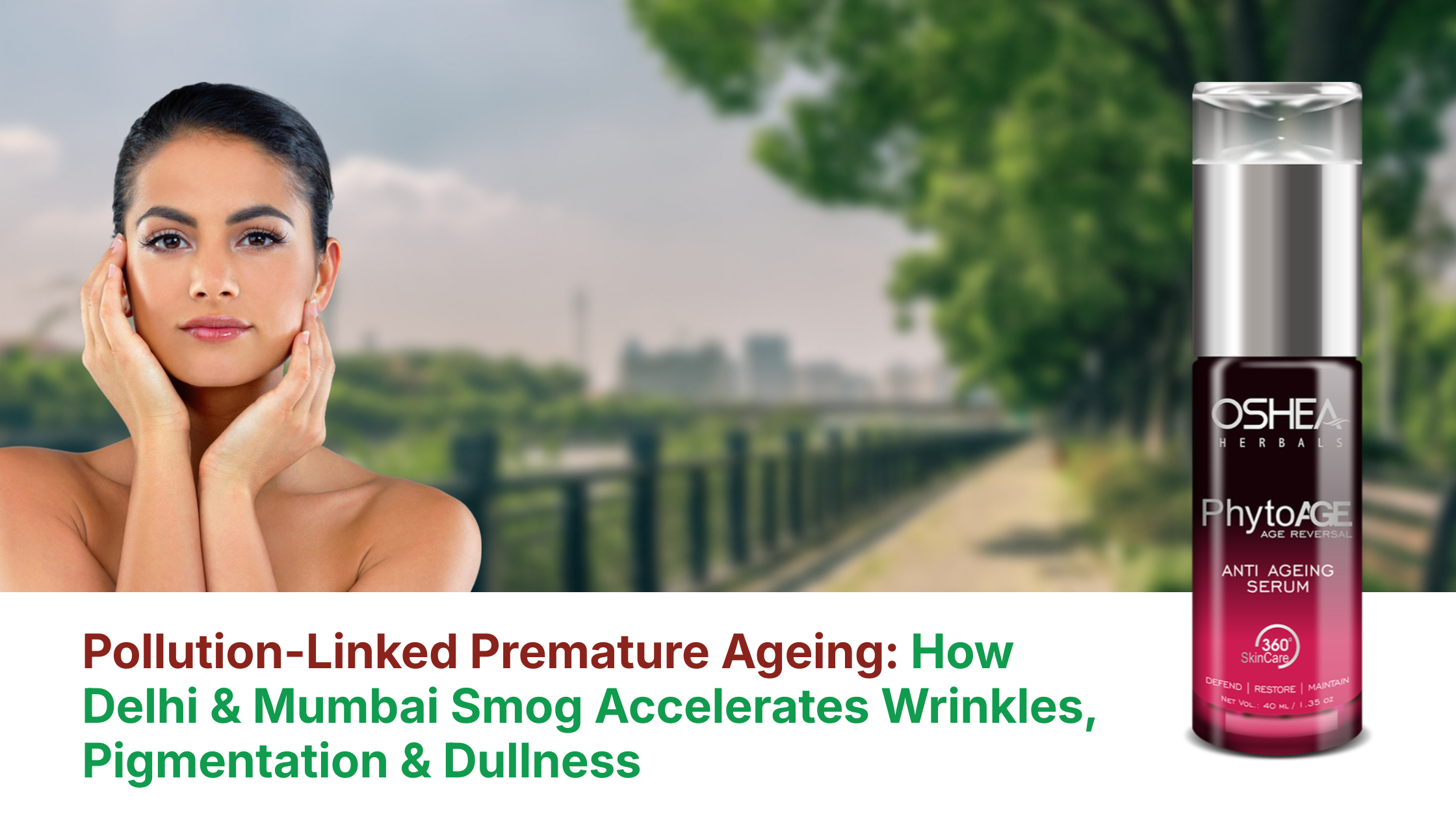
- Airborne particulate matter, especially PM2.5, is now recognised as a major driver of premature skin ageing in dense Indian cities.
- Smog accelerates three visible signs at once: deeper wrinkles, uneven pigmentation and a tired, grey dullness.
- Pollution damages skin mainly through oxidative stress, free radicals that overwhelm the skin's natural antioxidant defences.
- A protect-treat-repair routine of antioxidants, sunscreen and overnight recovery measurably reduces the daily damage.
- Cleansing matters, but over-washing weakens the barrier and makes dullness worse rather than better.
- Targeted ingredients like vitamin C, niacinamide, kojic acid and retinol address pollution-linked concerns directly.
- What Pollution-Linked Premature Ageing Really Means
- How Smog Damages Skin: The Core Mechanism
- The Three Visible Signs: Wrinkles, Pigmentation, Dullness
- Why Delhi and Mumbai Skin Is at Higher Risk
- The Science of Defence: Antioxidants and the Barrier
- Building an Anti-Pollution Routine
- Common Mistakes That Make Pollution Damage Worse
- Daily Care and Best Practices
- Expert Tips and Advanced Considerations
- Who Needs Anti-Pollution Skincare?
- Related Reading
- Frequently Asked Questions
If your skin looks more tired than it used to, if dark patches are appearing faster than your birthdays explain, or if a once-clear complexion now reads dull by mid-afternoon, the air you breathe may be a bigger culprit than your calendar. Across Delhi, Mumbai and most large Indian cities, the daily blanket of smog does more than irritate the lungs. It settles on skin, slips into pores, and sets off a chain of damage that shows up as wrinkles, pigmentation and a loss of glow. The good news is that this kind of ageing is largely preventable, and a focused routine built around anti-ageing skincare can slow it considerably.
This guide breaks down exactly how pollution speeds up skin ageing, what the science says, and how to defend your complexion without overcomplicating your shelf. Oshea Herbals has spent years formulating herbal-led skincare for Indian climate and pollution conditions, and our work is grounded in the standards documented across our awards and certifications. The aim here is honest, practical guidance, not hype.
Last reviewed: June 2026
1. What Pollution-Linked Premature Ageing Really Means
Skin ageing comes from two broad sources. Intrinsic ageing is the slow, genetically programmed change that happens to everyone over time. Extrinsic ageing is the part driven by the environment, and it is the part you can influence. For decades, sunlight was treated as the dominant external factor. Research over the last fifteen years has added a second major player to that list: air pollution.
Dermatologists now describe the full set of lifelong external exposures that shape how skin ages as the "exposome." Pollution sits near the top of that list alongside ultraviolet radiation, and in a high-smog city it can rival the sun for sheer cumulative impact. Premature ageing simply means these external factors are pushing visible change faster than your biological age would predict, so a person in their early thirties may show the pigment density and fine lines more typical of someone a decade older.
Pollution as an everyday exposure, not an occasional one
What makes pollution uniquely damaging is its constancy. A sunburn is an event you notice and can avoid. Smog is an invisible, around-the-clock exposure that most urban Indians cannot opt out of. That steady, low-grade assault is precisely why its effects creep up slowly and are easy to dismiss until the changes are well established.
The scale of exposure: The World Health Organization estimates that almost the entire global population breathes air exceeding its recommended pollutant limits, a problem that is especially acute across northern and western Indian cities during winter smog season.
2. How Smog Damages Skin: The Core Mechanism
To protect skin intelligently, it helps to understand the actual pathway of harm. Smog is a cocktail of particulate matter, ground-level ozone, nitrogen oxides and a range of organic compounds. The single most studied component for skin is particulate matter, sorted by size. The fine fraction, PM2.5, refers to particles measuring 2.5 micrometres or smaller. According to the United States Environmental Protection Agency's explanation of particulate matter, these particles are a fraction of the width of a human hair, which is exactly what makes them so troublesome.
Step one: particles settle and penetrate
Because PM2.5 is so small, it lodges easily into pores and the microscopic grooves of the skin surface. Many of these particles carry adsorbed toxins, notably polycyclic aromatic hydrocarbons, which are byproducts of combustion from traffic and industry. Once these particles sit on warm, slightly oily skin, their chemical cargo begins to react.
Step two: free radicals and oxidative stress
The core damage is oxidative. Pollutants generate reactive oxygen species, commonly called free radicals, which are unstable molecules that steal electrons from healthy skin structures. In small numbers the skin neutralises them with its own antioxidant network. Under heavy daily smog, that network is overwhelmed, and the resulting oxidative stress damages cell membranes, DNA and the collagen scaffolding that keeps skin firm.
Step three: inflammation and breakdown
Oxidative stress switches on inflammatory signalling and activates enzymes that break down collagen and elastin. It also disrupts the skin barrier, allowing moisture to escape and more irritants to enter, and it stimulates pigment-producing cells to overproduce melanin. This is how a single exposure pathway produces three different visible problems at once.
Ultraviolet light and pollution are not separate problems working in parallel. They amplify each other. UV exposure makes some airborne chemicals more reactive on skin, which is one more reason sunscreen belongs in every anti-pollution routine, not just a summer one.
3. The Three Visible Signs: Wrinkles, Pigmentation, Dullness
Pollution-linked ageing tends to announce itself through a recognisable trio. Understanding which sign maps to which mechanism makes it far easier to choose the right products rather than guessing.
| Visible Sign | What Causes It | How It Looks | Helpful Ingredients |
|---|---|---|---|
| Wrinkles and fine lines | Collagen and elastin broken down by oxidative stress and inflammation | Loss of firmness, lines around eyes and mouth, crepey texture | Retinol, peptides, vitamin C, niacinamide |
| Pigmentation and dark spots | Overproduction of melanin triggered by particles and UV | Uneven tone, brown patches, persistent dark spots | Vitamin C, kojic acid, alpha arbutin, niacinamide |
| Dullness and greyness | Surface congestion, dead-cell buildup and impaired barrier | Tired, lacklustre complexion, rough surface, lost glow | Gentle exfoliating acids, antioxidants, hydration |
Most urban skin shows a blend of all three. That is why a single hero product rarely solves the whole picture, and why a layered routine that protects, treats and repairs tends to outperform any one cream. For pigment concerns specifically, our pigmentation care range and de-pigmentation collection are formulated around these active ingredients.
4. Why Delhi and Mumbai Skin Is at Higher Risk
Not all urban skin faces the same pressure. Cities with persistently poor air quality place a heavier and more sustained oxidative load on the complexion, and India's two largest metros sit firmly in that category for different reasons.
Delhi: seasonal smog spikes
Delhi experiences dramatic winter smog when cooler air traps pollutants close to the ground, often pushing the air quality index into hazardous territory for weeks at a stretch. India's Central Pollution Control Board publishes the National Air Quality Index that tracks these spikes. For skin, those high-PM2.5 windows mean intensely concentrated exposure layered on top of the dry winter air that already weakens the barrier.
Mumbai: humidity plus traffic
Mumbai's profile is different. High humidity keeps skin oilier and pores more open, which can help fine particles adhere and settle, while dense traffic produces a steady stream of combustion pollutants year round. The coastal humidity also means many people under-moisturise, assuming oily skin needs no hydration, which quietly accelerates dullness.
The research signal: A long-running study of women living near busy roads, published in the Journal of Investigative Dermatology and indexed on PubMed, found that higher exposure to traffic-related particulate matter was associated with significantly more pigment spots and pronounced facial wrinkles.
5. The Science of Defence: Antioxidants and the Barrier
Since the central mechanism of pollution damage is oxidative stress, the central strategy of defence is antioxidant support paired with a strong skin barrier. These are the two levers that determine how much of the daily assault actually translates into visible ageing.
Daytime Defence Starts With the Right Day Cream
Carrotshield Anti-Pollution Day Cream layers antioxidant protection over your skin so fewer free radicals reach the structures that keep you looking youthful.
Shop Carrotshield Day CreamAntioxidants neutralise free radicals
Topical antioxidants act as sacrificial molecules, donating electrons to free radicals so your collagen and cell membranes do not have to. Vitamin C is the most researched, working both as an antioxidant and as a brightening agent that interrupts excess pigment production. A daily dose through a vitamin C face serum gives skin a meaningful head start against the day's exposure.
A healthy barrier keeps pollutants out
The barrier is the skin's outermost defensive layer. When it is intact and well-hydrated, fewer particles and toxins get through. When it is compromised by harsh cleansing, dryness or constant pollution, everything gets worse at once. Niacinamide is particularly useful here because it supports barrier function while also calming inflammation and fading pigmentation, which is why it appears across our niacinamide collection.
Antioxidant serums work best in the morning, ahead of the day's exposure, and sunscreen should always be the last protective step on top. Treating these as optional during smog season is the single most common gap in urban routines.
6. Building an Anti-Pollution Routine
A good anti-pollution routine is not about owning the most products. It is about covering three jobs reliably: protect during the day, treat the existing damage, and repair overnight. Here is a framework that works for most skin types in Indian conditions.
Morning: protect
- Gentle cleanse to remove overnight oil and any residue, using a face wash suited to your skin type from the face wash range.
- Antioxidant serum such as vitamin C to arm the skin against the day.
- Anti-pollution day cream like Carrotshield to add a protective, antioxidant-rich layer.
- Broad-spectrum sunscreen as the final step, every single day.
Evening: treat
- Thorough cleanse to lift away the day's accumulated grime and particles. An activated charcoal face wash is well suited to pollution-heavy days.
- Targeted treatment for your main concern: a pigment corrector such as a kojic acid and alpha arbutin serum for dark spots, or a retinol and peptide serum for fine lines.
- Moisturise to seal in treatment and support the barrier.
Night: repair
Skin does most of its repair work while you sleep. A nourishing night cream supports that overnight recovery and is the ideal moment for richer actives. Our night cream is formulated for this repair window.
7. Common Mistakes That Make Pollution Damage Worse
Many people unintentionally accelerate the very ageing they are trying to prevent. These are the recurring errors we see most often in urban routines.
Over-cleansing and over-scrubbing
The instinct to scrub away pollution is understandable but counterproductive. Aggressive cleansing strips protective oils, weakens the barrier, and leaves skin more vulnerable to the next day's exposure. Twice-daily gentle cleansing is the right cadence for almost everyone.
Skipping sunscreen on grey days
Smog and cloud cover do not stop ultraviolet rays, and UV magnifies pollution damage. Skipping sunscreen because the sky looks dull is one of the costliest habits for long-term skin health.
Ignoring the neck, hands and hairline
Pollution does not respect facial boundaries. The neck and hands often reveal age faster than the face precisely because they are forgotten in routines.
The most damaging mistake of all is going to bed without removing the day's pollution. Particles left on skin overnight continue generating free radicals for hours, turning your sleep, normally a repair window, into extra damage time.
8. Daily Care and Best Practices
Beyond the core routine, a handful of daily habits compound over time to keep pollution-linked ageing in check.
Double cleanse on high-pollution days
On days when the air quality index is poor, a two-step evening cleanse, an oil-based or micellar first pass followed by your regular face wash, lifts stubborn particulate residue more completely than a single wash.
Hydrate inside and out
A well-hydrated barrier resists pollutants better. Drink enough water, and do not skip moisturiser even if your skin is oily. Lightweight hydration supports the barrier without heaviness.
Support skin through diet
Antioxidants are not only topical. A diet rich in colourful fruits and vegetables supplies the vitamins and polyphenols that reinforce your internal antioxidant defences, complementing what you apply on the surface.
A simple daily benchmark: If you do only three things consistently, make them cleansing every evening, applying an antioxidant in the morning, and never skipping sunscreen. These three habits address the majority of pollution-linked damage on their own.
9. Expert Tips and Advanced Considerations
Once the basics are consistent, a few refinements help you get more from your routine without adding complexity.
Layer actives by time of day, not all at once
Vitamin C and antioxidants belong to mornings; retinol and stronger pigment correctors belong to evenings. Splitting actives across the day reduces irritation and lets each one work in its ideal window. Niacinamide is the rare active that pairs comfortably with almost anything, morning or night.
Do not forget indoor and screen exposure
Pollution does not stay outdoors, and screens emit visible blue light that also generates free radicals in skin. A daytime antioxidant layer plus sunscreen helps on both fronts, which is why the protection step matters even for people who rarely step outside.
Be patient and consistent
Pigmentation and texture respond over weeks and months, not days. The American Academy of Dermatology's guidance on sun protection reinforces that consistent daily defence, rather than occasional intensive treatment, is what produces lasting results. The same principle applies to pollution defence.
Compounding effect: Independent reviews summarised through the World Health Organization's air pollution resources underline that cumulative, long-term exposure is what drives chronic damage, which means consistent daily protection delivers far more value than any single corrective treatment.
10. Who Needs Anti-Pollution Skincare?
Anti-pollution skincare is not a niche concern for one type of person. Anyone living in or near a high-traffic, high-smog environment benefits, though the priorities shift by life stage and skin goal. Here is how different groups can focus their efforts.
- Pollution, led by PM2.5, is a major and constant driver of premature skin ageing in Indian cities, working largely through oxidative stress.
- The damage appears as three linked signs: wrinkles, pigmentation and dullness, all traceable to the same free-radical pathway.
- Defence rests on two pillars: daily topical antioxidants and a strong, well-hydrated skin barrier.
- A protect-treat-repair routine of antioxidant serum, anti-pollution day cream, sunscreen, targeted evening treatment and a repairing night cream covers the essentials.
- Over-cleansing, skipping sunscreen on grey days, and sleeping in the day's pollution are the most common mistakes that make damage worse.
- Consistency over weeks and months, not occasional intensive treatment, is what delivers visible, lasting improvement.
11. Related Reading
12. Frequently Asked Questions
Does air pollution really cause premature ageing of the skin?
Yes. Long-term studies of city dwellers show that exposure to airborne particulate matter is linked to more pigment spots and deeper wrinkles. Fine particles generate free radicals on and inside the skin, which break down collagen and trigger excess melanin, producing the visible signs we associate with ageing earlier than they would otherwise appear. A daily routine built around anti-ageing care helps counter this.
Which pollutant in Delhi and Mumbai smog is most damaging to skin?
Fine particulate matter known as PM2.5 is the biggest concern because the particles are small enough to settle into pores and carry toxic compounds such as polycyclic aromatic hydrocarbons. Ground-level ozone and nitrogen dioxide add to the oxidative load, but PM2.5 is the most consistently linked to pigmentation and wrinkles in research on urban populations.
Can a day cream actually protect skin from pollution?
An anti-pollution day cream creates a light barrier that limits how much grime adheres to the skin and supplies antioxidants that neutralise free radicals during the day. It does not replace cleansing or sunscreen, but used as part of a routine it reduces the daily oxidative damage that drives premature ageing. The Carrotshield day cream is built for exactly this job.
Is sunscreen necessary on smoggy or cloudy days in Indian cities?
Yes. Ultraviolet rays pass through haze and cloud cover, and smog itself does not block them meaningfully. UV exposure also amplifies the damage that pollution starts, so a broad-spectrum sunscreen of SPF 30 or higher remains essential every day regardless of how grey the sky looks. Browse options in the sunscreen range.
What ingredients help reverse pollution-related pigmentation and dullness?
Vitamin C, niacinamide, kojic acid and alpha arbutin help fade pollution-related pigmentation and restore radiance, while retinol and peptides support collagen to soften fine lines. Antioxidants protect, and gentle exfoliating acids clear the dull, congested surface layer that smog leaves behind.
How does smog cause wrinkles if I am indoors most of the day?
Indoor air is not pollution-free. Fine particles drift inside through windows and ventilation, and screens emit visible blue light that also generates free radicals in skin. Short daily commutes and outdoor errands add measurable exposure, so even a mostly indoor routine accumulates oxidative stress over months and years.
Can washing my face more often remove pollution damage?
Cleansing twice a day removes the particles and grime sitting on the surface, which is important, but over-washing strips the skin barrier and can make dullness and sensitivity worse. The goal is thorough but gentle cleansing, followed by antioxidants and moisture, rather than scrubbing harder or more frequently.
Which Oshea Herbals products are best for anti-pollution skincare?
A practical starting set is an activated charcoal face wash to lift grime, the Carrotshield anti-pollution day cream with antioxidants for daytime defence, a vitamin C or niacinamide serum to treat pigmentation and dullness, a broad-spectrum sunscreen, and a night cream to support overnight repair. Explore the full age-control range to assemble a routine.
At what age should I start an anti-pollution skincare routine?
Protection matters at every age because oxidative damage accumulates from the twenties onward. A simple routine of cleansing, antioxidants and sunscreen is sensible from the late teens or early twenties, with targeted treatments such as retinol and pigment correctors added in the late twenties and thirties as concerns appear.


