


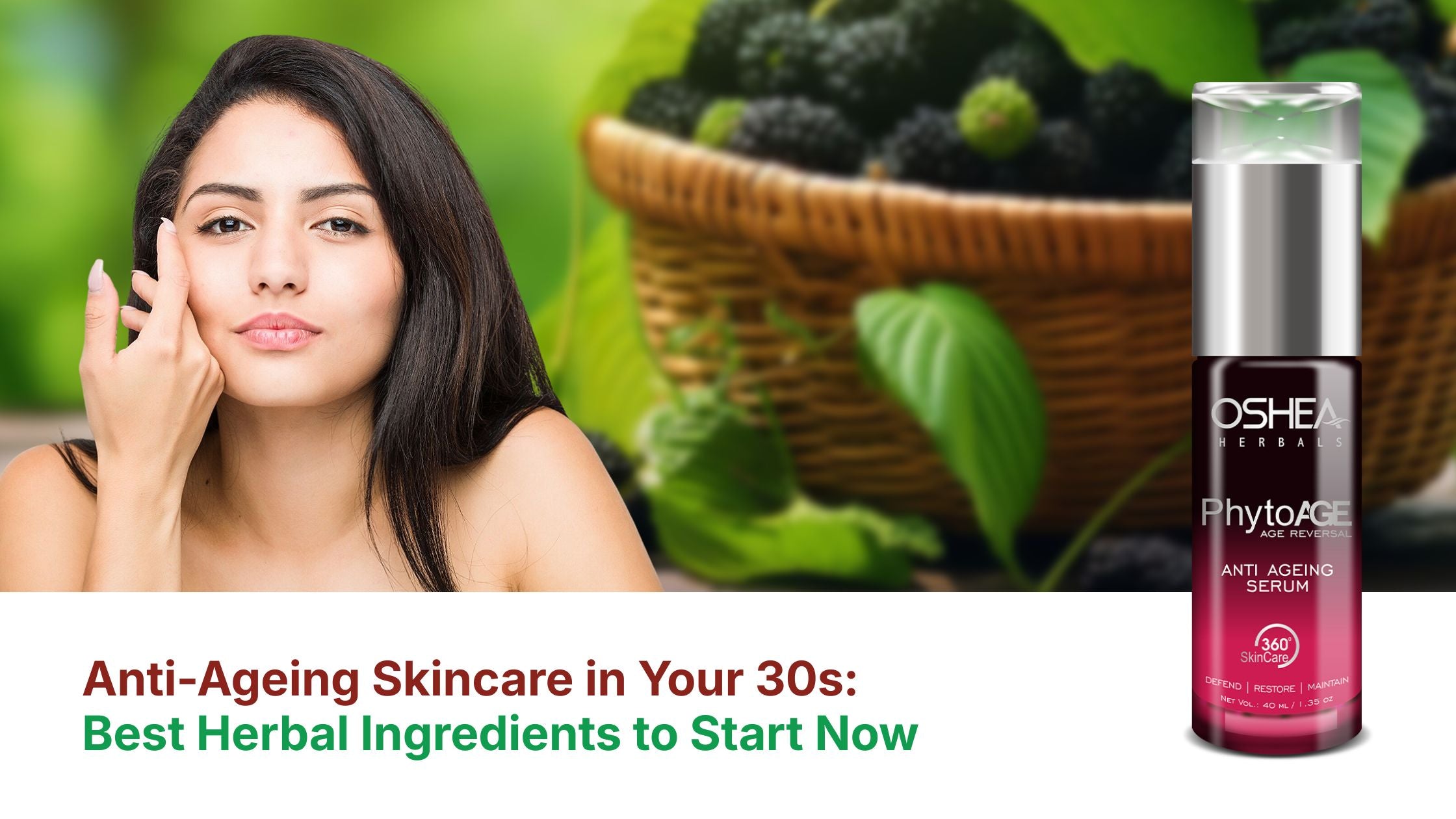
- Your 30s is the optimal window to begin anti-ageing skincare: collagen decline is measurable, early changes are visible, but the skin is still highly responsive to botanical intervention.
- For Indian skin, photoageing from UV exposure is the primary driver of visible premature ageing, making SPF 50 PA+++ the single highest-impact anti-ageing step in any 30s routine.
- Ginseng, ashwagandha, baobab oil, and cyclotetrapeptide are the core herbal actives in Oshea's PhytoAge range, each targeting a distinct mechanism of skin ageing.
- The PhytoAge range by Oshea Herbals provides a complete anti-ageing system: serum, cream, and emulsion for layered treatment at every step of the routine.
- Stress-ageing, driven by cortisol elevation, is a particularly significant contributor to premature skin ageing in Indian urban consumers; adaptogenic herbs like ashwagandha address this from the inside out.
- Anti-ageing skincare in your 30s is predominantly preventive: the goal is to slow the accumulation of changes rather than reverse changes that have already become established.
- 1. Why Your 30s Is the Right Time to Start
- 2. How Indian Skin Ages: The Specific Drivers
- 3. The Best Herbal Ingredients for Anti-Ageing in Your 30s
- 4. Building Blocks of an Effective 30s Anti-Ageing Routine
- 5. The Morning Anti-Ageing Routine: Step by Step
- 6. The Evening Anti-Ageing Routine: Step by Step
- 7. Common Anti-Ageing Mistakes to Avoid in Your 30s
- 8. Weekly and Monthly Intensive Treatments
- 9. Expert Insights on Early Anti-Ageing Intervention
- 10. Who Needs an Anti-Ageing Routine in Their 30s
- 11. Related Reading
- 12. Frequently Asked Questions
Thirty is a skincare milestone that too many people let pass without strategic action. By the time most Indian consumers notice the early signs of ageing, including the fine lines at the outer corners of the eyes, the subtle loss of bounce when pressing the cheek, the slightly longer recovery time after a late night, collagen has already been declining for 5 to 7 years. The good news is that starting an anti-ageing skincare routine in your 30s is the most effective timing of all: early enough that changes are still minor and highly reversible, and at an age where the skin remains highly responsive to botanical actives. Explore the Oshea Herbals Anti-Ageing Collection for herbal-powered formulas built for this exact window.
At Oshea Herbals, our PhytoAge range was developed with the understanding that the most effective anti-ageing intervention for Indian skin combines Ayurvedic adaptogenic herbs with modern peptide technology, addressing both the biochemical drivers of ageing and the environmental, UV-driven photoageing that is uniquely intense in India's climate.
Last reviewed: March 2026
1. Why Your 30s Is the Right Time to Start
Collagen production peaks in your mid-20s and then declines by approximately 1 percent per year from that point onward. Elastin, the protein that gives skin its bounce-back quality, follows a similar trajectory. In the early 20s, this decline is imperceptible; the skin regenerates faster than it ages. By the early 30s, the balance begins to shift. Cell turnover slows from every 14 to 21 days in the 20s to every 28 to 35 days, meaning dead cells accumulate more quickly and fresh skin cells take longer to reach the surface. The first visible consequences: fine lines, mild surface dullness, and slightly less plump skin texture.
The therapeutic window of the early 30s is the period when preventive actives, especially herbal botanicals that support collagen synthesis and antioxidant defence, can slow this progression dramatically. Anti-ageing skincare started at 30 is not vanity: it is the most evidence-efficient investment in skin health you will ever make, because prevention requires less intervention than reversal.
Collagen timeline: Research published in the British Journal of Dermatology found that facial skin thickness decreases by approximately 6 percent per decade from the age of 25, driven by declining fibroblast activity and increasing collagenase (collagen-degrading enzyme) production. Topical actives that inhibit collagenase activity or stimulate new fibroblast proliferation, such as retinoids, ginseng, and peptides, are most effective when applied during the period of gradual decline rather than after substantial thinning has occurred.
2. How Indian Skin Ages: The Specific Drivers
Indian skin ages differently from lighter skin tones in several measurable ways. Higher melanin density provides natural UVB protection (Indian skin has an inherent SPF of approximately 13 compared to 3 to 4 for very fair skin), meaning Indian consumers experience less surface-level UVB damage (sunburn) than their lighter-skinned counterparts. However, UVA rays, which penetrate deeper and degrade dermal collagen, affect Indian skin comparably to lighter tones. The result is an ageing pattern characterised more by deep structural changes (collagen loss, elastin degradation) and pigmentation than by surface burning and redness.
Additionally, Indian urban consumers face a convergence of specific ageing accelerators: chronic high UV exposure through much of the year, high pollution in major cities (which generates reactive oxygen species that degrade collagen), hard water (which disrupts the skin barrier), dietary stress, and workplace stress levels. This multi-factor ageing environment makes an Ayurvedic, adaptogenic anti-ageing approach particularly relevant for India, where addressing stress hormones alongside UV and oxidative damage is the most complete strategy.
Indian skin's higher melanin density is a natural advantage against UV-induced surface damage, but it also means that post-inflammatory hyperpigmentation from any skin stress, including acne, aggressive exfoliation, or irritant contact, is more pronounced. An anti-ageing routine for Indian skin in the 30s must prioritise gentleness: avoid irritating actives at high concentrations, introduce new ingredients gradually, and always maintain the skin barrier to prevent the PIH that disrupts an even, youthful complexion.
3. The Best Herbal Ingredients for Anti-Ageing in Your 30s
| Ingredient | Source | Primary Anti-Ageing Mechanism | Key Skin Benefit in 30s |
|---|---|---|---|
| Ginseng (Panax ginseng) | Korean/Chinese herbal medicine | Fibroblast stimulation, collagenase inhibition, antioxidant | Improves elasticity, reduces fine line depth |
| Ashwagandha (Withania somnifera) | Ayurvedic adaptogen | Cortisol reduction, anti-inflammatory, collagen support | Reduces stress-ageing, restores skin vitality |
| Baobab Oil (Adansonia digitata) | African baobab tree | Omega fatty acid barrier repair, antioxidant | Deep moisturisation, lipid layer restoration |
| Cyclotetrapeptide | Synthetic botanical peptide | Accelerates skin surface activity, smooths fine lines | Visible line reduction from first weeks of use |
| Vitamin C (Terminalia / Emblica) | Kakadu plum, amla | Collagen co-factor, tyrosinase inhibition, antioxidant | Brightening, anti-pigmentation, collagen support |
| Mulberry Extract | Morus alba (white mulberry) | Tyrosinase inhibition, melanin transfer blocking | Reduces age spots and uneven tone in 30s skin |
Ginseng: The Cell Renewal Herb
Panax ginseng's ginsenosides stimulate dermal fibroblasts, the cells responsible for collagen and elastin production, while simultaneously inhibiting matrix metalloproteinases (MMPs), the enzymes that break down existing collagen fibres. A clinical study on ginseng extract published on PubMed found measurable improvement in skin elasticity and a reduction in wrinkle area over 24 weeks of topical use in participants over 30, validating ginseng's anti-ageing efficacy in a clinical setting.
Ashwagandha: The Stress-Ageing Protector
Cortisol, the primary stress hormone, is a direct collagen antagonist: elevated cortisol suppresses fibroblast activity, increases collagenase expression, and accelerates the degradation of existing collagen in the dermis. For Indian urban consumers in their 30s managing career, family, and city life simultaneously, chronic cortisol elevation is a significant and underappreciated driver of premature skin ageing. Ashwagandha's withanolides have demonstrated cortisol-lowering activity in multiple clinical trials, making it a distinctively relevant anti-ageing herb for the Indian 30s demographic. The PhytoAge Skin Moisturising Emulsion incorporates ashwagandha alongside ginseng, baobab oil, and cyclotetrapeptide for this multi-pathway approach.
4. Building Blocks of an Effective 30s Anti-Ageing Routine
An anti-ageing routine for Indian skin in the 30s should be built around four non-negotiables: consistent sun protection (preventing new collagen damage), antioxidant defence (neutralising ongoing oxidative damage), active collagen support (stimulating new collagen and slowing its degradation), and hydration (maintaining the plump, dewy appearance that healthy collagen and barrier function produce).
Every other product in the routine is a bonus that amplifies these four pillars. The most common mistake in 30s anti-ageing skincare is investing in expensive treatment products while neglecting daily SPF, which renders the treatments significantly less effective by allowing continuous collagen damage to occur unchecked alongside the repair efforts.
Prevention vs repair efficiency: A clinical analysis reviewed in the Journal of Cosmetic Dermatology found that preventing UV-induced collagen damage through daily SPF use produces 3 to 4 times more net improvement in skin ageing scores at 5 years than equivalent investment in corrective treatments used without SPF. Starting SPF use consistently at 30 versus 35 produces a measurable difference in skin condition at 45, independent of any other treatment used. SPF is the highest-ROI anti-ageing investment available.
5. The Morning Anti-Ageing Routine: Step by Step
Start Your Anti-Ageing Journey with PhytoAge
The Oshea Herbals PhytoAge range brings ginseng, ashwagandha, baobab oil, and cyclotetrapeptide together in a serum, cream, and emulsion for a complete, layered 30s anti-ageing system.
Shop Anti-Ageing CollectionStep 1: Gentle Cleanse
Begin with a gentle, non-stripping cleanser. Harsh foaming cleansers that leave the face feeling tight strip the barrier lipids that become increasingly important in your 30s as natural ceramide production begins to slow. A mild herbal cleanser that maintains the skin's natural pH sets the right foundation for every subsequent anti-ageing product to absorb effectively.
Step 2: Antioxidant Serum
Apply a vitamin C serum from the Oshea Vitamin C range immediately after cleansing. Morning is the optimal time for vitamin C, as its antioxidant activity neutralises the free radicals generated by UV and pollution throughout the day. Vitamin C also enhances the UV-protective effect of your sunscreen when applied beneath it.
Step 3: Anti-Ageing Treatment
Apply the PhytoAge Anti-Ageing Serum, which combines Terminalia Ferdinandiana fruit extract (a natural vitamin C source), cyclotetrapeptide, ginseng, ginger, and aloe vera for intense moisture, firmness restoration, and wrinkle reduction. Allow 60 seconds for full absorption before the next layer.
Step 4: Moisturise and Protect
Apply the PhytoAge Skin Moisturising Emulsion to seal in the serum's actives and deliver its own dose of ashwagandha, ginseng, mulberry, and baobab oil. Finish with a broad-spectrum SPF 50 PA+++ as the final, non-negotiable morning step. The PhytoDERMA Hyaluronic Acid SPF 50 Sunscreen Gel adds additional hydration alongside its UV protection, making it an ideal choice for the anti-ageing morning routine.
6. The Evening Anti-Ageing Routine: Step by Step
Step 1: Double Cleanse
In the evening, cleanse twice: the first cleanse removes sunscreen, makeup, and the day's pollution. The second cleanse with a gentle herbal facewash deep-cleanses the skin surface for optimal active ingredient absorption from the evening treatment products.
Step 2: Evening Serum
The evening is when the skin's repair cycle peaks. Applying the PhytoAge Anti-Ageing Serum in the evening allows its collagen-supporting and cell-renewal actives to work during the hours of peak fibroblast activity, maximising the benefit of each application.
Step 3: Night Cream
The PhytoAge Age Reversal Creme with Paeonia Suffruticosa, Ribes nigrum, and solidago extract is specifically formulated to accelerate skin surface renewal and reduce fine line and wrinkle depth. Its richer texture compared to the daytime emulsion provides the overnight occlusion that supports barrier repair and maximises peptide and botanical absorption during sleep.
The sleep position you maintain through the night contributes to the formation of sleep lines: creases from pillow pressure that, over years, become permanent wrinkles. Sleeping on your back eliminates this pressure-based line formation entirely. If you cannot sleep on your back, a silk or satin pillowcase significantly reduces friction and mechanical compression on facial skin compared to cotton, which visibly reduces sleep-line formation over time.
7. Common Anti-Ageing Mistakes to Avoid in Your 30s
Skipping SPF Because You Are Indoors Most of the Day
UVA rays penetrate glass and reach skin even through office windows, car windscreens, and indoor glass partitions. The collagen-degrading effect of UVA is continuous wherever glass separates you from daylight. Apply SPF 50 every morning regardless of whether you expect sustained direct sun exposure. This one habit, maintained consistently from the early 30s, prevents more visible skin ageing than any other single intervention.
Introducing Too Many Actives Simultaneously
The 30s skincare market is flooded with ingredients: retinoids, AHAs, BHAs, vitamin C, niacinamide, peptides, and more. Introducing several new actives simultaneously prevents you from identifying which ingredient is producing results (or causing irritation), increases the risk of barrier disruption, and can trigger PIH in Indian skin. Introduce one new active at a time, at two-week intervals, and assess the response before adding the next.
Never use retinol and vitamin C in the same evening application step. Both are active at low pH and, when combined at high concentrations, can cause irritation, increased UV sensitivity, and barrier compromise. Apply vitamin C in the morning and retinol in the evening, or alternate days. If using retinol, reduce active exfoliant days and prioritise barrier repair with ceramide-rich moisturisers through the skin's adaptation period.
Neglecting the Neck and Hands
The neck and décolletage age at the same rate as the face but receive a fraction of the product attention. Apply all facial anti-ageing products down to the upper chest. The backs of the hands are exposed to UV daily and show ageing (dark spots, thinning skin) as rapidly as the face. Include hands in your SPF application every morning and use the anti-ageing serum on the hands two to three times per week.
8. Weekly and Monthly Intensive Treatments
Beyond the daily routine, two to three monthly intensive treatments significantly amplify anti-ageing progress. A facial kit such as the Oshea Herbals Facial Kit range delivers concentrated botanical actives in a multi-step professional-style treatment that penetrates more deeply than daily products. Monthly facial kit treatments are one of the most effective ways to maintain visible skin vitality throughout the 30s alongside a consistent daily anti-ageing routine.
Twice-weekly exfoliation with a gentle face scrub supports the anti-ageing routine by accelerating cell turnover and ensuring the freshly surfaced skin cells are not obscured by accumulated dead cells. Faster cell turnover means the newer, more evenly pigmented cells spend more time on the visible surface, contributing to a more radiant, even-toned complexion that reads as younger and more vital.
9. Expert Insights on Early Anti-Ageing Intervention
The dermatological consensus on anti-ageing skincare timing is consistent: preventive treatment begun in the 30s is exponentially more effective per product used than corrective treatment begun in the 40s or 50s. This efficiency advantage comes from the skin's greater biological responsiveness at 30 to 35, where fibroblast activity is still robust enough to respond meaningfully to stimulation from botanical actives and peptides.
A long-term study on sun-protected versus non-sun-protected Indian skin cohorts, reviewed in a published review on photoageing in skin of colour on NCBI, found that participants who consistently applied broad-spectrum SPF from their late 20s and early 30s showed dramatically less visible ageing by age 50 than matched cohorts who began SPF use in their 40s. The photoprotection advantage compounded over decades was more significant than any other topical intervention studied. This finding reinforces the hierarchy of 30s anti-ageing: SPF first, active botanicals second.
Ingredient synergy in PhytoAge: The combination of cyclotetrapeptide and ginseng in the PhytoAge Age Reversal Creme produces a particularly well-validated pairing. Cyclotetrapeptide accelerates the desmosomal renewal of surface skin cells (similar to the mechanism of prescription retinoids but without their irritation profile), while ginseng's ginsenosides support the fibroblast activity needed to produce the new collagen that fills the space left by accelerated surface cell turnover. The two actives address the skin's surface and structural layers simultaneously.
10. Who Needs an Anti-Ageing Routine in Their 30s
- Your 30s is the optimal window for anti-ageing skincare: early enough to prevent, responsive enough to benefit dramatically from botanical intervention.
- SPF 50 PA+++ every morning is the single highest-impact anti-ageing investment; it prevents UV-triggered collagen degradation that no product can fully repair.
- Ginseng, ashwagandha, baobab oil, and cyclotetrapeptide in the PhytoAge range address four distinct ageing mechanisms: fibroblast stimulation, stress-hormone moderation, barrier repair, and surface renewal acceleration.
- Introduce actives one at a time, two weeks apart, to identify what works and avoid the barrier disruption that causes PIH in Indian skin.
- The neck, hands, and décolletage age at the same rate as the face and deserve the same anti-ageing product attention.
- Monthly facial kit treatments and twice-weekly exfoliation amplify the daily routine by accelerating cell turnover and delivering concentrated botanicals at deeper penetration.
11. Related Reading
12. Frequently Asked Questions
When should I start an anti-ageing skincare routine in India?
Your 30s is the ideal time to begin a targeted anti-ageing skincare routine. Collagen production begins to decline measurably from the mid-20s, but the visible signs, fine lines, early loss of elasticity, and emerging dark spots, become more apparent in the early 30s. Starting preventive treatment in your 30s allows botanical actives like ginseng, ashwagandha, and vitamin C to slow the visible progression before changes become established.
Which herbal ingredients are most effective for anti-ageing in Indian skin?
For Indian skin in your 30s, the most effective herbal anti-ageing ingredients are ginseng (for cell renewal and collagen support), ashwagandha (for adaptogenic stress protection), vitamin C from natural sources (for antioxidant protection and collagen synthesis), and cyclotetrapeptide (for firming and line reduction). The PhytoAge Emulsion combines all of these in one formula.
Is it too early to use anti-ageing products in your 30s?
No. The 30s is precisely the right window. Anti-ageing skincare in your 30s is predominantly preventive, slowing the collagen degradation and melanin accumulation that would otherwise accelerate through the decade. Beginning in your 40s means addressing changes that have been accumulating for 10 or more years, requiring more intensive intervention for equivalent results.
Can I use an anti-ageing cream daily in my 30s?
Yes. Anti-ageing creams formulated with herbal botanicals and peptides are designed for daily use, morning and evening. The PhytoAge Age Reversal Creme from Oshea Herbals is formulated for daily application. Sporadic use produces significantly weaker results than the consistent daily habit.
What is the most important anti-ageing step for someone in their 30s in India?
Sun protection is the single most impactful anti-ageing step. Photoageing from UV exposure accounts for the majority of visible premature ageing in Indian skin. A consistent daily SPF 50 PA+++ applied every morning prevents UV-triggered collagen breakdown and melanin accumulation. The PhytoDERMA Hyaluronic Acid SPF 50 provides protection alongside hydration for a convenient morning application.
How does ginseng help with skin ageing?
Ginseng's ginsenosides stimulate dermal fibroblasts (collagen-producing cells) and inhibit matrix metalloproteinases (collagen-degrading enzymes). Multiple peer-reviewed studies confirm measurable improvement in skin elasticity and reduction in wrinkle area with topical ginseng use, validating its inclusion in the PhytoAge Anti-Ageing Serum.
Does ashwagandha help with skin ageing?
Yes. Ashwagandha is an adaptogenic herb that reduces cortisol levels. Elevated cortisol from chronic stress suppresses fibroblast activity and accelerates collagen degradation. By moderating the skin's stress hormone response, ashwagandha supports collagen maintenance and reduces the stress-ageing component that is significant for Indian urban consumers in their 30s.
Can I use a retinol product in my 30s?
Yes. The 30s is an ideal time to introduce a low-concentration retinol (0.1 to 0.2 percent) into your evening routine. Start with twice-weekly application and build to daily use over 4 to 8 weeks. Always apply retinol at night, always follow with SPF the next morning, and pair with a rich moisturiser to prevent initial dryness.


