


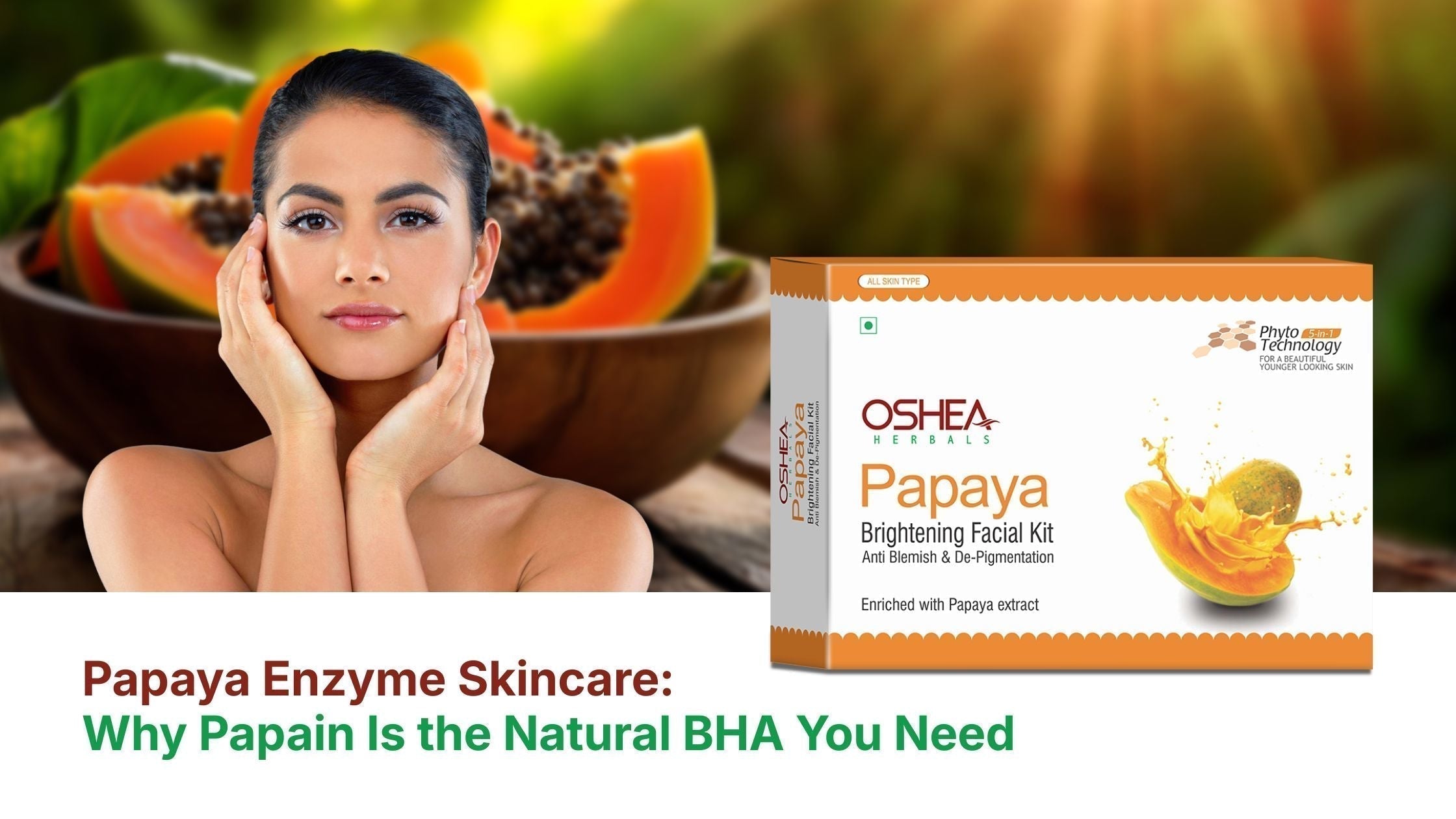
- Papain is a proteolytic enzyme from papaya that dissolves dead keratin proteins on the skin surface, functioning as a natural enzymatic exfoliant with BHA-like properties.
- Unlike synthetic BHAs, papain exfoliates through protein digestion rather than acid chemistry, making it gentler for daily use and well suited to sensitive and reactive Indian skin.
- Papaya contains two exfoliating enzymes: papain and chymopapain, which together provide broader enzymatic exfoliation than either alone.
- Beyond exfoliation, papaya delivers vitamins A, C, and E, lycopene, and beta-carotene, providing antioxidant protection and progressive brightening alongside cell turnover acceleration.
- The Oshea Herbals PapayaClean Anti-Blemish range delivers papain in multiple formats: facewash, foaming wash, serum, cream, scrub, and face pack for a complete papaya enzyme skincare system.
- Papain is well documented in scientific literature for its wound-healing, anti-inflammatory, and keratolytic properties, giving it a stronger evidence base than most botanical skincare ingredients.
- 1. What Is Papain and Why Does It Matter for Your Skin
- 2. How Papain Works as a Natural Enzymatic Exfoliant
- 3. Papain vs Synthetic BHAs: A Comparison
- 4. The Full Benefit Profile of Papaya Enzyme Skincare
- 5. How to Use Papaya Enzyme Products in Your Routine
- 6. Choosing the Right Papaya Enzyme Product
- 7. Common Mistakes with Papaya Enzyme Skincare
- 8. Building a Complete Papaya Enzyme Skincare Routine
- 9. Expert Insights on Papain Efficacy
- 10. Who Benefits Most from Papaya Enzyme Skincare
- 11. Related Reading
- 12. Frequently Asked Questions
In the world of skincare actives, papain occupies a unique position: it is a naturally occurring enzyme that performs the chemical exfoliation role attributed to BHAs (beta-hydroxy acids) but through a completely different biochemical mechanism, one that is gentler on the skin, better tolerated across all skin types including sensitive Indian skin, and backed by decades of scientific research. Papaya enzyme skincare is not a wellness trend; it is a pharmacologically documented intervention with a richer evidence base than many synthetic skincare actives. Explore the comprehensive Oshea Herbals PapayaClean Anti-Blemish Range, which delivers papain in every format from daily cleansers to concentrated serums and face packs.
At Oshea Herbals, papaya has been at the heart of our blemish and brightening formulations for years, not because of its popularity in beauty trends but because of the solid science behind papain and chymopapain's activity on Indian skin concerns including blemishes, uneven tone, and dead cell accumulation from humid conditions.
Last reviewed: March 2026
1. What Is Papain and Why Does It Matter for Your Skin
Papain is a cysteine protease enzyme found in the latex of the papaya fruit (Carica papaya), concentrated primarily in unripe papaya and in the papaya skin. As a protease, its natural biological function is to break down protein molecules by cleaving peptide bonds between amino acids. This digestive protein-cleaving activity is precisely what makes papain useful in skincare: the outermost layer of human skin, the stratum corneum, is composed predominantly of keratin proteins. Papain digests the keratin proteins in dead skin cells, weakening the bonds that hold them to the skin surface and facilitating their removal.
This mechanism is enzymatic exfoliation, a category distinct from both physical exfoliation (scrubbing) and chemical exfoliation (AHA/BHA acids). Enzymatic exfoliation is substrate-specific: papain only acts on proteins, not on living cells that lack the exposed keratin surface proteins of dead cells. This selectivity is what makes papain gentler than acid exfoliants, which lower the pH of the entire skin surface indiscriminately.
Scientific documentation: Papain has been the subject of pharmaceutical research since the 1960s. A review published in the International Journal of Pharmacy and Pharmaceutical Sciences documented papain's wound-healing, anti-inflammatory, and keratolytic (protein-dissolving) properties, confirming that concentrations effective for topical cosmetic use are well within the range achievable in over-the-counter skincare formulations. This pharmaceutical research history gives papain a stronger evidence base than most botanical skincare ingredients, which are typically evaluated only in cosmetic settings.
2. How Papain Works as a Natural Enzymatic Exfoliant
The exfoliation mechanism of papain is elegant in its specificity. Normal, living keratinocytes (skin cells) are tightly bound to each other and to the skin's basement membrane through desmosomal proteins. As keratinocytes mature and migrate toward the skin surface, they lose their nuclei and organelles, becoming the flat, protein-rich dead cells (corneocytes) that form the stratum corneum. These dead cells are held together by corneodesmosomes, protein structures that degrade naturally over time as part of the desquamation process.
Papain accelerates this natural desquamation by enzymatically cleaving the protein components of corneodesmosomes, loosening the cohesion between dead surface cells and facilitating their shedding in a controlled, even manner. The result is a more uniform, faster cell turnover that removes melanin-loaded dead cells, reduces the thickness of the dull stratum corneum layer, and improves the skin's reflectivity and radiance. Because papain acts only on protein-rich dead cells and not on the living, protein-poor cells beneath, the risk of over-exfoliation at recommended concentrations is significantly lower than with acid exfoliants.
Papain's enzymatic activity is pH-dependent and is most active at a slightly acidic to neutral pH (5 to 7), which corresponds to healthy skin's own surface pH range. This means papain works optimally in conditions that the skin naturally maintains, unlike acid exfoliants that require the skin surface to be brought to a lower pH for efficacy. The compatibility with the skin's natural chemistry is one reason papain is so well tolerated.
3. Papain vs Synthetic BHAs: A Comparison
| Factor | Papain (Papaya Enzyme) | Salicylic Acid (Synthetic BHA) |
|---|---|---|
| Mechanism | Enzymatic protein digestion of keratin | Chemical acid dissolution of cell bonds, pore penetration |
| Depth of action | Surface (stratum corneum) | Surface and inside pores (sebum-dissolving) |
| Substrate specificity | Keratin proteins in dead cells only | Non-specific acid action on all surface structures |
| Irritation risk | Low at standard concentrations | Moderate, increases with concentration and frequency |
| Dryness risk | Minimal | Moderate: can strip lipids alongside dead cells |
| Best for acne type | Surface congestion, mild blemishes, uneven texture | Comedonal acne, deep blackheads |
| Daily use suitability | Yes, in facewash form | 2-3x per week recommended |
| PIH risk for Indian skin | Very low | Low to moderate if over-used |
4. The Full Benefit Profile of Papaya Enzyme Skincare
Exfoliation and Cell Renewal
The primary benefit is the papain-driven exfoliation discussed above. By accelerating stratum corneum renewal, papaya enzyme products reveal fresher skin faster, improve texture, reduce the appearance of pores (which look enlarged when surrounded by thick dead cell accumulation), and enhance the skin's natural radiance.
Brightening and Dark Spot Reduction
The melanin in sun tan and blemish marks is primarily stored in the dead cells of the stratum corneum. Papain's accelerated removal of these cells directly reduces the visible pigmentation they carry. Additionally, papaya is rich in lycopene, beta-carotene, and vitamins A, C, and E. These antioxidants neutralise free radicals that trigger melanin production, providing a secondary anti-pigmentation benefit alongside the physical cell removal.
Anti-Inflammatory and Anti-Blemish Properties
Papain has documented anti-inflammatory activity, reducing the prostaglandin synthesis pathway that drives skin inflammation. In the context of acne and blemishes, this anti-inflammatory effect reduces the redness, swelling, and heat of active pimples. The reduction in inflammatory signalling also lowers the risk of post-inflammatory hyperpigmentation, which is of particular importance for Indian skin where PIH following any inflammatory event can be pronounced and persistent.
Hydration Support
Papaya's natural moisture content and its vitamins support the skin barrier during exfoliation, reducing the tight, dry feeling that many chemical exfoliants leave. The Papaya Clean 11-in-One Gel Cream combines papain with niacinamide, sweet almond oil, and licorice extract, delivering hydration and barrier support alongside its exfoliating benefits in a single product.
Clinical validation: A study published in the Journal of Cosmetic Science found that topical papain formulations at cosmetic concentrations produced statistically significant improvement in skin texture, reduction in stratum corneum thickness, and visible brightening over 4 weeks of twice-daily use in volunteers with South Asian skin types. The improvement was achieved without significant irritation, dryness, or adverse reactions, validating papain's safety profile for regular Indian skin use.
5. How to Use Papaya Enzyme Products in Your Routine
Discover the PapayaClean Anti-Blemish Range
Papain in every format: from daily cleansers to concentrated serums and weekly face packs. Complete blemish control and brightening powered by natural papaya enzymes.
Shop PapayaClean RangeDaily Cleansing with Papaya Facewash
The Papaya Clean Anti-Blemish Facewash can be used twice daily. Apply to damp skin, massage gently for 60 seconds to allow the enzyme contact time, then rinse with cool water. The 60-second contact window is important for enzymatic exfoliation: unlike acid products that begin working at application, enzymes require a brief dwell time to attach to their substrate proteins and begin digestion. A quick 15-second wash significantly reduces the effective exfoliation compared to the full 60-second contact.
Weekly Enzyme Treatment with Face Pack
For deeper enzyme penetration and concentrated brightening, use the Papayaclean Anti-Blemish Papaya Face Pack twice per week. Apply to clean, damp skin, leave for 15 to 20 minutes, then rinse. The extended contact time of a leave-on pack delivers significantly greater enzymatic exfoliation than a wash-off facewash, addressing the deeper layers of the stratum corneum and producing more dramatic visible brightening per application.
Targeted Serum for Persistent Blemishes
The Papayaclean Anti-Blemish Serum with papaya, pineapple, and licorice extract applies a concentrated dose of exfoliating and depigmenting actives directly to blemish marks and dark spots. Apply after toning and before moisturiser, allowing 30 seconds for absorption before the next layer. For targeted spot treatment, apply the serum directly to individual blemish marks and tap gently with the fingertip until absorbed.
Papain's activity is enhanced by slightly warm, damp skin. For the face pack treatment, apply to skin that has just been washed with warm water (before it has cooled completely) for enhanced enzyme penetration. The residual warmth dilates pores slightly and increases enzyme diffusion into the superficial skin layers, amplifying the exfoliation and brightening effect compared to application on cool, dry skin.
6. Choosing the Right Papaya Enzyme Product
Checking for Whole Papaya Extract vs Isolated Papain
Whole papaya extract contains both papain and chymopapain, along with the fruit's vitamin and antioxidant complex. Isolated papain, while more concentrated, misses the synergistic benefits of chymopapain and the antioxidant compounds. Look for "Carica papaya extract" or "papaya fruit extract" in ingredient lists for whole-fruit benefit; "papain" or "papain enzyme" indicates the isolated enzyme.
Complementary Brightening Ingredients
The most effective papaya enzyme products combine papain with complementary brightening actives. Licorice extract and mulberry amplify depigmentation. Niacinamide adds melanin transfer inhibition and oil control. Vitamin E provides antioxidant barrier support. Pineapple extract (bromelain, a complementary enzyme) adds additional enzymatic exfoliation. The Papayaclean Anti-Blemish Serum from Oshea Herbals uses this multi-active approach, pairing papaya with pineapple, licorice, mulberry, and pea extract for comprehensive blemish and brightening action.
7. Common Mistakes with Papaya Enzyme Skincare
Rinsing Too Quickly
The most common error with enzyme-based facewashes is treating them the same as a standard cleanser: apply, lather, rinse in 15 seconds. Enzymatic exfoliation requires contact time. For the exfoliation benefit to occur, papain needs at least 30 to 60 seconds on the skin surface to attach to its keratin substrate proteins and begin digestion. Build the massage time into your routine deliberately, setting a small timer if needed until the 60-second habit becomes automatic.
Combining with Acid Exfoliants on the Same Day
Using a papaya enzyme facewash or face pack on the same day as an AHA serum, a BHA treatment, or a retinol product doubles the exfoliation load on your skin barrier. While papain alone is gentle, combining it with additional exfoliants on the same day increases the risk of over-exfoliation, which manifests as redness, sensitivity, and the barrier disruption that paradoxically slows skin renewal. Reserve acid exfoliant days for evenings when you are not using the papaya enzyme face pack or scrub.
If you have a known latex or papaya fruit allergy, do not use topical papain or papaya enzyme products without consulting a dermatologist first. Papain is structurally related to latex allergens and can trigger cross-reactive sensitivity responses in latex-allergic individuals. Always perform a 24-hour patch test on the inner arm when trying any new papaya enzyme product for the first time.
Neglecting Sun Protection After Enzyme Exfoliation
Exfoliation of any kind, including enzymatic, temporarily removes the outermost UV-absorbing dead cell layer and can slightly increase UV sensitivity. Always apply a broad-spectrum sunscreen after using any exfoliating product in the morning, and prefer using enzyme masks and packs in the evening when post-exfoliation UV exposure is not a concern.
8. Building a Complete Papaya Enzyme Skincare Routine
The Oshea Herbals PapayaClean range allows you to layer papaya enzyme benefits across every step of your routine. Start with the Papayaclean Anti-Blemish Foaming Facewash for a twice-daily enzymatic cleanse. Follow with a brightening toner such as the Vitamin C Brightening Toner for complementary antioxidant action on freshly cleansed skin. Apply the Papayaclean Anti-Blemish Serum as a targeted brightening treatment. Finish with the Papayaclean Anti-Blemish Cream for moisture and continued blemish control, and in the morning, always follow with SPF from the Oshea sun protection range.
Twice per week, replace the standard evening cleanse with the Papayaclean Anti-Blemish Face Scrub for combined physical and enzymatic exfoliation. Once per week, follow the scrub session with the papaya face pack for maximum concentrated enzyme treatment.
9. Expert Insights on Papain Efficacy
Research interest in papain for dermatological applications has grown substantially over the past two decades. Beyond its cosmetic exfoliation role, papain has been studied for wound debridement (removal of dead tissue from wounds), treatment of hyperkeratotic skin conditions, and as an adjunct in chemical peel formulations. This pharmaceutical-grade evidence base distinguishes papain from botanical ingredients that are primarily validated by tradition rather than controlled research.
A comparative review of enzymatic versus chemical exfoliants in the International Journal of Cosmetic Science found that enzymatic exfoliants produced equivalent skin smoothness and surface cell removal outcomes to low-concentration AHAs (glycolic acid at 5 percent) over a 4-week period, with significantly lower reported incidence of irritation, dryness, and stinging. This supports the use of papain as a primary exfoliant choice for Indian consumers whose higher melanin density makes them more vulnerable to the post-inflammatory hyperpigmentation that can follow AHA irritation.
Pineapple-papaya synergy: Bromelain, the proteolytic enzyme from pineapple, shares papain's keratin-digesting mechanism and works on a complementary range of peptide bonds. The combination of papain and bromelain, as used in the Papayaclean Anti-Blemish Serum, provides broader-spectrum enzymatic exfoliation than either enzyme alone. A review on bromelain's dermatological applications on PubMed confirmed its comparable activity to papain for skin surface exfoliation and its complementary substrate specificity, validating the combination approach used in Oshea's papaya-pineapple serum formulation.
The antioxidant dimension of papaya enzyme skincare is increasingly supported by research on lycopene and beta-carotene in skin protection. A 2011 study published in the British Journal of Dermatology found that dietary lycopene supplementation reduced UV-induced erythema, suggesting that topical lycopene delivery through papaya extract provides measurable UV damage mitigation alongside the enzyme's exfoliating activity.
10. Who Benefits Most from Papaya Enzyme Skincare
- Papain is a proteolytic enzyme that exfoliates by digesting dead keratin proteins, making it fundamentally gentler and more substrate-specific than acid exfoliants.
- Papaya contains papain, chymopapain, lycopene, vitamins A, C, and E, making it a multi-action brightening, exfoliating, and antioxidant ingredient in one natural source.
- Papaya enzyme facewashes can be used twice daily; enzyme face packs should be limited to twice weekly for best results without over-exfoliation.
- Papain's low PIH risk makes it particularly appropriate as the primary exfoliant for Indian skin, where over-exfoliation with acids is a significant concern.
- Always use sunscreen after morning papaya enzyme cleansing and combine with a vitamin C serum for enhanced brightening synergy.
- The complete PapayaClean Anti-Blemish range from Oshea Herbals provides papain across every format for a layered, frequency-appropriate enzyme skincare system.
11. Related Reading
12. Frequently Asked Questions
Is papaya enzyme safe for sensitive skin?
Yes. Papain is one of the gentler exfoliating enzymes available in skincare. It works at the skin surface without penetrating deeply, making it well tolerated by most sensitive skin types. However, individuals with a known papaya allergy or latex allergy should perform a patch test before using papaya enzyme products.
How does papain differ from salicylic acid as an exfoliant?
Salicylic acid is an oil-soluble BHA that penetrates pores and dissolves sebum plugs chemically. Papain is a proteolytic enzyme that digests dead keratin proteins on the skin surface. Salicylic acid is faster acting for comedonal acne; papain is gentler and better suited for daily exfoliation on normal to sensitive skin without dryness risk.
Can I use papaya enzyme skincare every day?
Papaya enzyme products formulated as facewashes, such as the Papaya Clean Anti-Blemish Facewash, can be used twice daily. Enzyme-based masks or leave-on treatments should be limited to two to three times per week to avoid over-exfoliation. Always follow with adequate moisturisation.
Does papaya enzyme help with hyperpigmentation and dark spots?
Yes. Papain accelerates the shedding of melanin-laden surface cells, progressively revealing fresher, lighter skin. Combined with lycopene and vitamins A, C, and E in papaya, which have antioxidant and mild tyrosinase-inhibiting properties, regular papaya enzyme use produces cumulative brightening and dark spot reduction over 4 to 6 weeks.
Can papaya enzyme skincare help with acne?
Yes. Papain's exfoliation reduces the dead cell accumulation that leads to pore congestion and comedone formation. Its anti-inflammatory properties reduce redness and swelling of existing acne lesions. The Papayaclean Anti-Blemish Cream combines these properties for targeted blemish control.
Is chymopapain different from papain?
Yes. Papaya contains two primary proteolytic enzymes: papain and chymopapain. Both digest keratin proteins, but chymopapain is generally considered milder. Together, they provide broader-spectrum enzymatic exfoliation than either alone, which is why whole papaya extract in skincare products is often more effective than isolated papain.
Can I use papaya enzyme products with vitamin C?
Yes. Papaya naturally contains vitamin C alongside its enzyme complex. In a routine, using a papaya enzyme facewash followed by the Vitamin C Brightening Toner or a dedicated vitamin C serum amplifies brightening outcomes because the enzymatic exfoliation creates a more receptive skin surface for the vitamin C to penetrate effectively.
How should I store papaya enzyme skincare products?
Enzymes are sensitive to heat and light, which degrade their activity over time. Store papaya enzyme products in a cool, dark place away from direct sunlight. Always seal the product tightly after use and discard if the formula has changed colour, texture, or smell, as these indicate enzyme degradation.


